
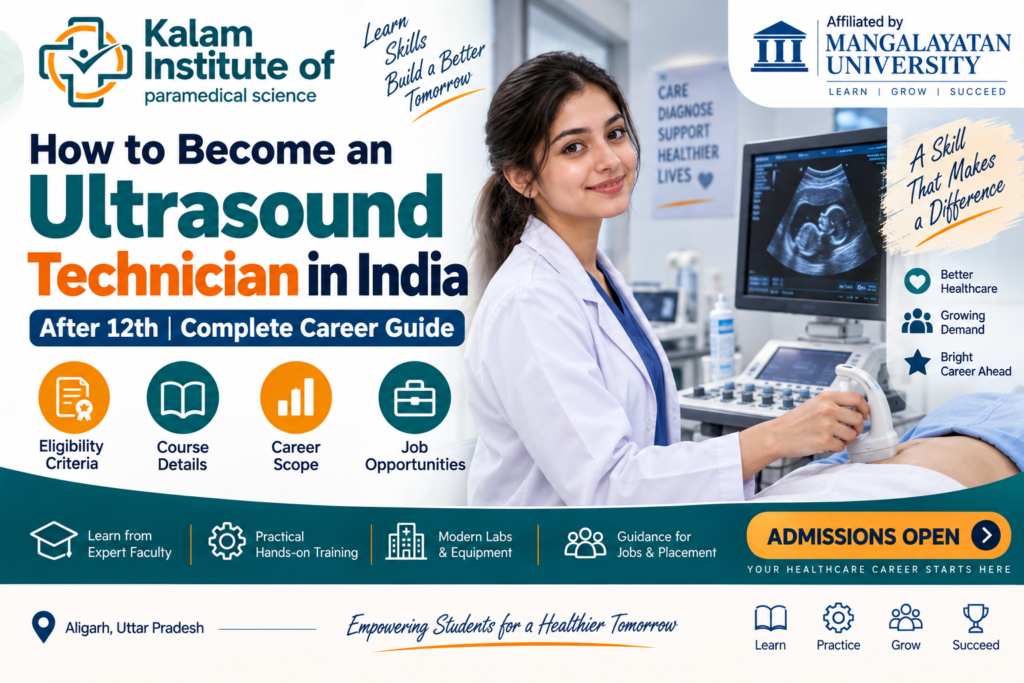
How to Become an Ultrasound Technician in India After 12th | Affiliated by Mangalayatan University
Healthcare is becoming one of the most popular career sectors among students in India. Along with doctors and nurses, hospitals and diagnostic centres require trained professionals who can work with medical technology, imaging systems, laboratories, and patient-care services.
One career that attracts many science students is ultrasound and diagnostic imaging.
If you are searching for how to become an ultrasound technician in India after 12th, it is important to understand the education pathway, eligibility, skills, career opportunities, and professional limitations associated with ultrasound-related work.
Students interested in healthcare technology can explore relevant paramedical and diagnostic imaging programs through an institute affiliated with Mangalayatan University, depending on the courses currently offered and their eligibility requirements.
This guide explains the career pathway in simple terms so that students can make an informed decision after completing Class 12.
What Is Ultrasound Technology?
Ultrasound is a medical imaging technology that uses high-frequency sound waves to create images of structures inside the human body.
It is commonly used in different areas of healthcare, including abdominal examinations, obstetrics and gynecology, vascular imaging, cardiac imaging, and other diagnostic procedures.
An ultrasound machine sends sound waves into the body through a device called a transducer. These waves return as echoes and are converted into images that healthcare professionals can examine.
Because ultrasound does not use ionizing radiation like conventional X-rays, it has become an important diagnostic tool in modern healthcare.
Who Is an Ultrasound Technician?
The term ultrasound technician is commonly used for professionals involved in supporting ultrasound imaging procedures.
Depending on the healthcare setting and applicable rules, their responsibilities may involve:
- Preparing patients for procedures
- Assisting with ultrasound equipment
- Supporting imaging professionals
- Maintaining equipment
- Preparing examination rooms
- Managing basic documentation
- Following infection-control procedures
- Assisting qualified medical professionals
- Helping with patient positioning
However, students must understand an important distinction.
In India, independently performing, interpreting, or reporting ultrasound examinations may be restricted to appropriately qualified and registered medical professionals under applicable healthcare laws and regulations.
Therefore, completing a general paramedical or ultrasound-related course does not automatically give a student the legal authority to independently conduct or interpret every type of ultrasound examination.
Always verify the exact professional scope of a course before taking admission.
Can You Become an Ultrasound Technician After 12th?
Students can begin studying diagnostic imaging, medical imaging technology, radiology, or certain ultrasound-related healthcare programs after Class 12 if they meet the eligibility requirements of the selected course.
However, the exact route depends on:
- Your Class 12 subjects
- Your chosen course
- University eligibility rules
- Current healthcare regulations
- Professional registration requirements
- The type of role you want to pursue
Students should therefore differentiate between studying ultrasound-related technology and becoming legally qualified to independently perform diagnostic ultrasound procedures.
Eligibility for Ultrasound-Related Courses After 12th
Eligibility requirements vary according to the program and institution.
For many paramedical and medical imaging programs, students may be required to complete 10+2 with science subjects.
Common eligibility conditions may include:
- Completion of Class 12 from a recognized board
- Physics, Chemistry, and Biology or other required science subjects
- Minimum qualifying marks as prescribed by the institution
- Minimum age criteria where applicable
- Required admission documents
Some programs may have different academic requirements.
Students should always check the official eligibility criteria before applying.
Step-by-Step Guide: How to Become an Ultrasound Technician in India After 12th
Students interested in this career can follow a structured approach.
Step 1: Complete Class 12
The first step is completing your 10+2 education.
Students from a science background are generally better positioned for medical imaging and paramedical courses because the field requires knowledge of biology, anatomy, physics, and healthcare science.
Step 2: Choose the Right Healthcare Course
After Class 12, students should select an appropriate diagnostic imaging or paramedical program.
Depending on availability and eligibility, students may explore courses related to:
- Medical imaging technology
- Radiology technology
- Diagnostic imaging
- Allied health sciences
- Imaging assistance
- Ultrasound-related healthcare technology
Course names can vary between universities and institutions.
Students should not select a program based only on the word “ultrasound” in its title.
Always verify what qualification is awarded and what professional activities that qualification legally permits.
Step 3: Study Anatomy and Physiology
Understanding the human body is essential in diagnostic imaging.
Students generally need to develop knowledge of:
- Human anatomy
- Physiology
- Pathology
- Medical terminology
- Patient positioning
- Clinical procedures
These subjects create the foundation needed for working in healthcare environments.
Step 4: Learn Medical Imaging Principles
Students pursuing diagnostic imaging education may learn the principles behind different imaging technologies.
This can include topics such as:
- Basic ultrasound physics
- Medical imaging principles
- Equipment handling
- Image formation
- Patient preparation
- Safety procedures
- Medical documentation
The exact syllabus depends on the selected program.
Step 5: Develop Practical Skills
Healthcare education should include practical learning whenever applicable.
Students may gain experience through:
- Laboratory sessions
- Equipment demonstrations
- Clinical observations
- Supervised practical training
- Hospital exposure
- Internship opportunities
Practical training helps students understand how medical facilities function in real-world situations.
Step 6: Complete the Required Internship or Clinical Training
Some healthcare programs may include internship or clinical training as part of the curriculum.
Internships can help students gain exposure to:
- Hospital operations
- Diagnostic departments
- Patient interaction
- Healthcare documentation
- Equipment maintenance
- Medical teamwork
- Professional conduct
Students should check whether practical or clinical training is included before choosing a course.
Step 7: Understand Legal and Professional Requirements
This is one of the most important steps for anyone interested in ultrasound-related work in India.
Ultrasound facilities and diagnostic procedures are regulated under Indian law, including rules associated with prenatal diagnostic techniques.
The ability to independently conduct, supervise, interpret, or report ultrasound examinations may require specific medical qualifications, registration, training, and authorization.
Students should verify the current requirements with the relevant university, healthcare authority, employer, and applicable regulatory bodies before choosing a professional pathway.
Ultrasound Technician Course After 12th
Students frequently search for an ultrasound technician course after 12th.
The exact program available may vary from one institution to another.
Some institutions may offer broader diagnostic or medical imaging courses instead of a standalone ultrasound technician qualification.
Programs can potentially include diploma, undergraduate, certificate, or allied-health pathways depending on the institution.
Before applying, students should confirm:
- Exact course name
- Duration
- Eligibility
- University affiliation
- Curriculum
- Practical training
- Internship
- Examination structure
- Qualification awarded
- Career scope
- Professional limitations
Never rely only on promotional claims when selecting a healthcare course.
Subjects Students May Study
The curriculum differs by program, but students pursuing medical imaging or ultrasound-related education may encounter subjects such as:
Human Anatomy
Students learn about different organs, tissues, bones, muscles, and systems of the human body.
Human Physiology
Physiology explains how different organs and body systems function.
Basic Pathology
Students learn how diseases affect tissues and organs.
Medical Terminology
Medical terminology helps students understand commonly used healthcare language.
Imaging Physics
Students may study how different medical imaging technologies produce diagnostic images.
Ultrasound Principles
Where included in the curriculum, students may learn basic concepts related to sound waves, transducers, image formation, and equipment.
Patient Care
Healthcare professionals must understand safe and respectful patient interaction.
Hospital Procedures
Students may learn clinical documentation, infection control, hygiene, safety, and professional conduct.
Skills Required for an Ultrasound-Related Career
A successful healthcare career requires more than technical knowledge.
Students should develop several professional abilities.
Attention to Detail
Medical imaging requires accuracy.
Professionals must pay close attention to equipment, procedures, documentation, and patient information.
Communication Skills
Healthcare staff interact with patients, doctors, nurses, administrators, and technical teams.
Clear communication is extremely important.
Technical Ability
Students should feel comfortable learning how healthcare equipment works.
Patient Handling
Some patients may feel nervous or uncomfortable during medical procedures.
Healthcare professionals should communicate politely and professionally.
Teamwork
Medical imaging professionals work as part of larger healthcare teams.
Professional Ethics
Confidentiality, patient dignity, safety, and professional responsibility are essential in healthcare.
Career Opportunities After an Ultrasound or Medical Imaging Course
Career opportunities depend heavily on the qualification completed and the professional scope permitted under applicable regulations.
Students may explore supporting or technical roles in areas such as:
- Diagnostic centres
- Hospitals
- Medical imaging departments
- Radiology departments
- Healthcare clinics
- Imaging centres
- Medical equipment companies
- Healthcare organizations
Possible job titles may include, depending on qualification and employer requirements:
- Medical Imaging Assistant
- Diagnostic Imaging Technician
- Radiology Technician
- Imaging Department Assistant
- Healthcare Technician
- Medical Equipment Assistant
- Clinical Support Technician
Some positions may require additional training, registration, experience, or professional qualifications.
Where Can Ultrasound-Related Professionals Work?
Professionals with appropriate qualifications may find opportunities in different healthcare environments.
These may include:
- Government hospitals
- Private hospitals
- Diagnostic laboratories
- Imaging centres
- Specialty clinics
- Multi-specialty hospitals
- Healthcare organizations
- Medical technology companies
Employment eligibility will depend on the exact qualification and the responsibilities associated with the role.
Scope of Ultrasound and Diagnostic Imaging in India
Medical imaging continues to play an important role in healthcare.
Doctors increasingly rely on diagnostic technologies to assess medical conditions, guide treatment, and monitor patients.
As healthcare infrastructure expands, professionals with knowledge of diagnostic imaging technology may find opportunities across hospitals and diagnostic facilities.
However, career growth depends on factors such as:
- Academic qualification
- Practical experience
- Professional skills
- Location
- Employer requirements
- Additional certifications
- Applicable regulations
Students should focus on genuine skill development rather than only completing a certificate.
Is Ultrasound Technology a Good Career After 12th?
For students interested in healthcare, medical technology, anatomy, and diagnostic procedures, an imaging-related career can be worth exploring.
Potential advantages include:
- Entry into the healthcare industry
- Technology-oriented work
- Practical learning
- Opportunities in hospitals and diagnostic centres
- Multiple diagnostic imaging career pathways
- Scope for further education
At the same time, students must understand that ultrasound is a regulated area of healthcare.
The qualification you choose should match the specific career role you plan to pursue.
Difference Between Ultrasound Technician and Sonologist
Students often use these terms interchangeably, but they are not necessarily the same.
Ultrasound Technician
This term is commonly used for a technical or supporting professional working around ultrasound or medical imaging services.
The exact responsibilities depend on qualifications and local regulations.
Sonologist
A sonologist is generally a medical professional involved in diagnostic ultrasound interpretation and reporting.
In India, professional eligibility for sonography and ultrasound practice is governed by specific legal and medical requirements.
A paramedical qualification should therefore not be assumed to be equivalent to a medical sonology qualification.
Importance of the PCPNDT Act in Ultrasound Practice
Students considering ultrasound as a career should be aware that prenatal diagnostic practices and ultrasound centres in India are subject to regulatory controls.
The Pre-Conception and Pre-Natal Diagnostic Techniques (Prohibition of Sex Selection) Act, commonly known as the PCPNDT Act, regulates several activities associated with prenatal diagnostic procedures.
The law is designed, among other purposes, to prevent misuse of prenatal diagnostic technology for sex selection.
Because regulations and professional eligibility can be detailed, students should verify current rules with relevant authorities before taking admission or accepting any job involving ultrasound procedures.
Why Choose an Institute Affiliated with Mangalayatan University?
University affiliation is an important factor while selecting a healthcare course.
Students considering an institute affiliated with Mangalayatan University can look for a structured academic environment, course curriculum, examination process, and qualification framework according to the program offered.
Before admission, students should verify:
- Whether the selected course is currently affiliated
- Course duration
- Eligibility criteria
- Examination structure
- Practical training
- Internship opportunities
- Qualification awarded
- Career scope
Verification is especially important in medical imaging and ultrasound-related education because different qualifications can lead to very different professional roles.
Why Study Paramedical Courses in Aligarh?
Students from Aligarh and nearby areas may prefer studying locally instead of relocating to another city.
Choosing a paramedical institute in Aligarh may provide benefits such as:
- Easier accessibility
- Reduced relocation expenses
- Opportunity to stay close to family
- Access to healthcare-focused education
- Local practical training opportunities
- Career-oriented learning
Students should compare different institutes based on academic quality rather than choosing only according to location.
What to Check Before Taking Admission
Before taking admission into any ultrasound or medical imaging program, ask the institute the following questions:
- What is the exact name of the course?
- Which university is the institute affiliated with?
- Is the course currently approved and affiliated?
- What qualification will I receive?
- What is the course duration?
- What are the eligibility criteria?
- Is practical training included?
- Is an internship provided?
- What equipment will students learn about?
- What jobs can graduates apply for?
- Can graduates independently perform ultrasound examinations?
- Is additional registration required?
- What are the limitations of the qualification?
- What is the complete fee structure?
These questions can help students avoid confusion later.
Higher Education Options
Students may continue their education after completing an eligible paramedical or medical imaging qualification.
Depending on their academic background, they may explore:
- Bachelor’s-level healthcare education
- Advanced medical imaging programs
- Allied health science programs
- Healthcare management
- Specialized diagnostic technology programs
- Master’s-level studies where eligible
Higher education can help students develop advanced technical, academic, managerial, or supervisory skills.
Common Mistakes Students Should Avoid
Students entering healthcare education should avoid making decisions based only on advertisements.
Choosing a Course Without Checking Recognition
Always verify the qualification, affiliation, and professional scope.
Assuming Every Ultrasound Course Allows Independent Scanning
This is incorrect.
Eligibility to independently perform or interpret ultrasound examinations can be legally restricted.
Ignoring Practical Training
Healthcare is a practical field.
Choose programs that provide appropriate hands-on learning where applicable.
Selecting a Course Only for Salary
Interest, aptitude, skills, qualification, and professional regulations are equally important.
Not Checking Career Eligibility
Ask exactly which jobs you can apply for after graduation.
Frequently Asked Questions
How can I become an ultrasound technician after 12th in India?
Students can explore eligible diagnostic imaging, medical imaging, radiology, or ultrasound-related healthcare programs after Class 12. The exact pathway depends on the qualification, eligibility, university requirements, and applicable healthcare regulations.
Which stream is required for an ultrasound-related course?
Many medical imaging and paramedical programs prefer or require students from a science background. Exact subject requirements vary by course and institution.
Can I become an ultrasound technician after 12th science?
Students with Class 12 science can explore relevant medical imaging and paramedical programs, provided they meet the institution’s eligibility criteria.
Can a paramedical student perform ultrasound independently?
Students should not assume that completing a paramedical course automatically permits independent ultrasound practice. Professional eligibility in India can be subject to specific medical, registration, training, and legal requirements.
Is ultrasound technology a good career in India?
Diagnostic imaging can offer career opportunities within India’s healthcare sector. Career outcomes depend on qualification, experience, practical skills, employer requirements, and applicable regulations.
Where can I study ultrasound-related courses in Aligarh?
Students can explore relevant healthcare and paramedical programs offered by institutes in Aligarh, including programs through institutes affiliated with Mangalayatan University. Always verify the exact course and current affiliation before admission.
What is the duration of an ultrasound technician course?
Course duration varies according to whether the program is a certificate, diploma, undergraduate, or broader medical imaging qualification. Students should check the official course structure before applying.
Can I work in a hospital after an ultrasound-related course?
Depending on your qualification and employer requirements, you may be eligible for technical or supporting positions in hospitals, imaging centres, diagnostic centres, and other healthcare organizations.
Conclusion
Students searching for how to become an ultrasound technician in India after 12th should begin by understanding that ultrasound is both a technical and regulated field of healthcare.
The right starting point is to complete Class 12, explore an appropriate medical imaging or paramedical qualification, develop strong practical skills, gain clinical exposure, and understand exactly what professional activities the qualification permits.
Students interested in studying in Aligarh can explore healthcare career courses through an institute affiliated with Mangalayatan University, subject to the current availability, eligibility, affiliation, and professional scope of the selected program.
Before taking admission, always confirm the exact qualification, university affiliation, practical training, internship opportunities, applicable regulatory requirements, and career outcomes.
With the right education, practical knowledge, and a clear understanding of professional responsibilities, students can build a strong foundation for a career in medical imaging and the broader healthcare industry.
Start your healthcare journey by exploring paramedical and diagnostic imaging courses in Aligarh affiliated with Mangalayatan University and choose the program that best matches your career goals.