Choosing a career after Class 12 is one of the most important decisions a student makes. For students from the science stream who want to enter the healthcare sector, the options can seem endless. While courses such as MBBS and BDS are well known, the healthcare industry also offers many other professional pathways.
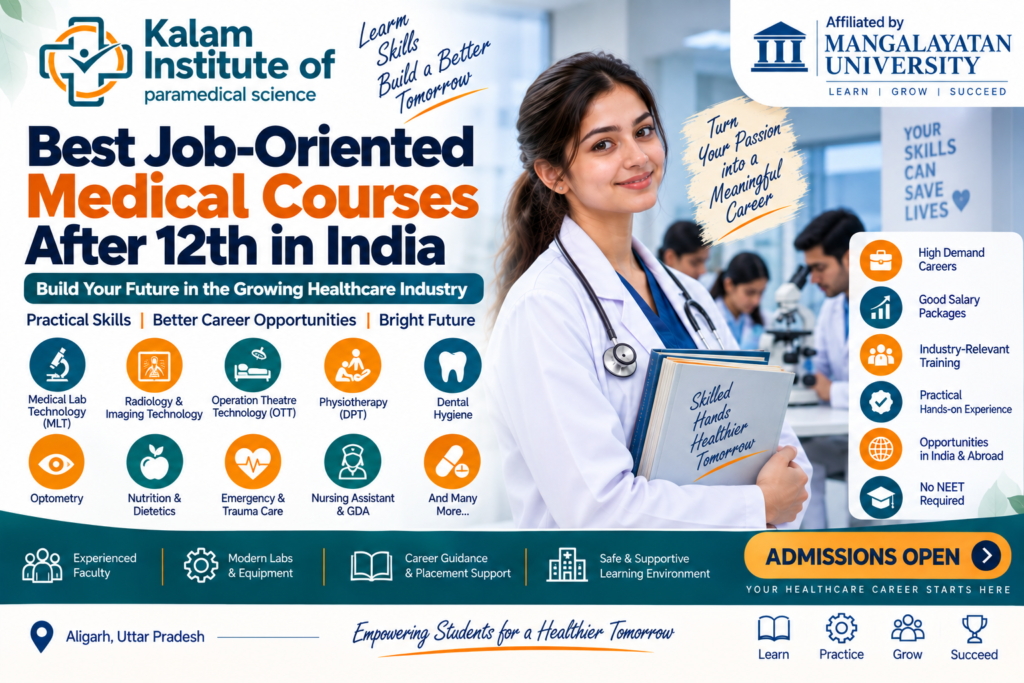
Job-oriented medical and paramedical courses after 12th can help students develop practical skills for specific areas of healthcare, including medical laboratories, diagnostic imaging, and operation theatre services.
These courses are particularly interesting for students who want to combine science with practical, technology-driven healthcare work.
Mangalayatan University offers several programs in allied healthcare and paramedical sciences. Its current 2026–27 admission information includes B.Sc. Medical Lab Technology, B.Sc. Medical Radiology & Imaging Technology, and B.Sc. Operation Theatre Technology, along with advanced diploma programs in these areas.
In this guide, we will explore some of the best job-oriented healthcare courses after 12th, their eligibility, career opportunities, course duration, skills required, and factors to consider before choosing a program.
What Are Job-Oriented Medical Courses?
Job-oriented medical courses are programs designed to provide students with specialized knowledge and practical skills for specific roles within the healthcare industry.
Rather than covering medicine as a broad discipline, these programs focus on particular areas such as:
- Medical laboratory testing
- Medical imaging
- Operation theatre services
- Diagnostic technology
- Clinical support
- Healthcare technology
These professionals generally work alongside doctors, nurses, radiologists, surgeons, and other healthcare professionals.
The exact duties and professional scope depend on the qualification, specialization, workplace, and applicable regulations.
Why Choose a Job-Oriented Healthcare Course After 12th?
Students often choose specialized healthcare courses because they want a practical and focused career pathway.
1. Practical Skills
Many allied healthcare programs combine classroom education with practical training, allowing students to learn how healthcare equipment, procedures, and systems are used.
2. Specialized Career Path
Instead of pursuing a broad medical education, students can develop expertise in a particular area of healthcare.
3. Multiple Career Environments
Qualified professionals can potentially work in hospitals, diagnostic centres, laboratories, imaging facilities, surgical centres, and research organizations.
4. Opportunity for Further Education
Many students can continue their education after completing their initial qualification through advanced diplomas, specialized training, or higher-degree programs, subject to eligibility.
5. Growing Role of Healthcare Technology
Modern healthcare increasingly depends on diagnostics, laboratory testing, imaging, and specialized technical services.
Best Job-Oriented Medical Courses After 12th
There is no single course that is best for every student. Your ideal course depends on your interests, academic background, and career goals.
Here are some popular healthcare-oriented options to consider.
1. B.Sc. Medical Lab Technology
B.Sc. Medical Lab Technology (MLT) is a strong option for students who enjoy biology, laboratory work, and medical science.
Medical laboratory professionals work with clinical samples and perform tests that provide information used by healthcare professionals.
Students may study:
- Hematology
- Clinical biochemistry
- Microbiology
- Immunology
- Pathology
- Molecular biology
- Diagnostic cytology
- Laboratory safety
- Quality control
Mangalayatan University’s current admission information lists B.Sc. Medical Lab Technology as a three-year undergraduate program plus internship, with eligibility of 10+2 in PCB/PCM and at least 50% aggregate marks.
Career Opportunities After B.Sc. MLT
Graduates may explore roles such as:
- Medical Laboratory Technician
- Clinical Laboratory Technician
- Laboratory Technologist
- Research Laboratory Technician
- Quality Control Technician
- Laboratory Supervisor
Potential workplaces include:
- Hospitals
- Diagnostic laboratories
- Pathology centres
- Blood banks
- Research facilities
- Biotechnology organizations
2. B.Sc. Medical Radiology & Imaging Technology
If you are interested in medical technology, diagnostic imaging, and working with sophisticated equipment, B.Sc. Medical Radiology & Imaging Technology can be an option worth considering.
Radiology and imaging professionals help produce diagnostic images using appropriate medical imaging equipment.
Depending on their training and workplace, imaging technologies may include:
- X-ray
- CT
- MRI
- Fluoroscopy
- Mammography
- Other specialized imaging systems
Mangalayatan University currently lists B.Sc. Medical Radiology & Imaging Technology as a three-year program plus internship. The listed eligibility is 10+2 with PCB/PCM and a minimum 50% aggregate.
Career Opportunities
Depending on qualifications and specialization, graduates may explore positions such as:
- Radiology Technician
- Radiographer
- X-Ray Technician
- Imaging Technician
- CT Technician
- MRI Technician
Some specialized roles may require additional education or training.
3. B.Sc. Operation Theatre Technology
For students who are interested in surgery, medical equipment, and clinical environments, B.Sc. Operation Theatre Technology can be an interesting career pathway.
Operation Theatre Technologists support surgical teams before, during, and after procedures.
Students can learn about:
- Surgical instruments
- Sterilization
- Infection control
- Patient preparation
- Operation theatre equipment
- Anesthesia-related concepts
- Surgical procedures
- Operation theatre management
Mangalayatan University currently lists B.Sc. Operation Theatre Technology as a three-year undergraduate program plus internship, with 10+2 PCB/PCM and at least 50% aggregate marks as the listed eligibility requirement.
Career Opportunities
Graduates may explore roles such as:
- Operation Theatre Technician
- Operation Theatre Technologist
- Surgical Technologist
- OT Assistant
- Anesthesia Technician
- OT Supervisor
4. Advanced Diploma in Medical Lab Technology
Students looking for a shorter specialized pathway can consider an Advanced Diploma in Medical Lab Technology.
Mangalayatan University’s current information lists the program as two years, with 10+2 and a minimum 50% aggregate in PCB/PCM as the eligibility requirement.
The course focuses on laboratory procedures, diagnostic testing, sample handling, equipment, safety, and quality practices.
Potential career areas include:
- Medical laboratories
- Diagnostic centres
- Pathology facilities
- Research laboratories
- Quality-control departments
5. Advanced Diploma in Medical Radiology & Imaging Technology
Students interested in medical imaging can also explore the Advanced Diploma in Medical Radiology & Imaging Technology.
Mangalayatan University currently lists this as a two-year program. The curriculum is focused on imaging technology and the technical skills required in diagnostic imaging environments.
Potential career areas include:
- X-ray departments
- Diagnostic imaging centres
- Hospitals
- Specialty clinics
- Imaging facilities
6. Advanced Diploma in Operation Theatre Technology
For students interested in surgical environments, an Advanced Diploma in Operation Theatre Technology offers another pathway.
Mangalayatan University’s current program information lists it as a two-year course for eligible 10+2 students.
Students learn about operation theatre procedures, surgical instruments, sterilization, patient care, equipment, and clinical support.
Potential job areas include:
- Hospitals
- Surgical centres
- Trauma centres
- Specialty hospitals
- Operation theatres
Degree vs Diploma: Which Is Better?
This is an important question for students after Class 12.
Both degree and diploma programs can have value, but they serve different academic goals.
Factor | Degree | Diploma |
Academic level | Undergraduate | Diploma |
Duration | Usually longer | Usually shorter |
Learning | Broader academic foundation | More focused specialization |
Higher studies | Can provide broader progression options | Depends on qualification and eligibility |
Career pathway | Suitable for students seeking a degree | Suitable for students seeking focused training |
The right choice depends on your academic plans and long-term career objectives.
If you want a broader undergraduate qualification and may pursue higher education later, a B.Sc. program may be worth considering.
If you prefer a shorter specialized program, a diploma pathway may be more suitable.
Eligibility for Medical and Paramedical Courses After 12th
Eligibility varies from course to course.
For the current B.Sc. paramedical programs at Mangalayatan University, the listed requirements include:
- 10+2 or equivalent qualification
- PCB/PCM subjects
- Minimum 50% aggregate marks
- Minimum age of 17 years on December 31 of the admission year
The current information also lists 10+2 with at least 50% in PCB/PCM for the advanced diploma programs.
Students should always confirm the latest eligibility requirements for the specific academic session before applying.
Career Scope After Job-Oriented Medical Courses
Healthcare is a large sector with many specialized departments.
Depending on your qualification, you can explore career opportunities in:
Hospitals
Hospitals employ laboratory, imaging, operation theatre, and other allied healthcare professionals.
Diagnostic Centres
Diagnostic facilities require trained professionals for laboratory testing and medical imaging.
Pathology Laboratories
Medical laboratory professionals can work in pathology and diagnostic laboratories.
Imaging Centres
Radiology professionals can work with X-ray, CT, MRI, and other imaging services according to their qualifications.
Surgical Centres
Operation Theatre Technologists can support surgical teams and theatre operations.
Research Institutions
Students with an interest in scientific research can explore laboratory and research-related positions.
Pharmaceutical and Biotechnology Companies
Certain qualifications may also provide pathways into technical, laboratory, quality-control, or research-support positions.
Government Jobs After Medical and Paramedical Courses
Government healthcare organizations can provide career opportunities for eligible professionals.
Potential workplaces include:
- Government hospitals
- Public healthcare institutions
- Government laboratories
- Medical colleges
- Research organizations
- Defence healthcare facilities
- State healthcare departments
However, completing a course does not guarantee a government job.
Candidates need to meet the specific eligibility requirements and recruitment conditions for each vacancy.
Private Sector Career Opportunities
The private healthcare sector is another major employment area.
Professionals may find opportunities in:
- Private hospitals
- Corporate hospitals
- Diagnostic chains
- Imaging centres
- Pathology laboratories
- Surgical centres
- Research organizations
- Healthcare companies
Career growth depends on factors such as education, practical skills, experience, specialization, location, and employer requirements.
Skills You Need for a Successful Healthcare Career
A good qualification is important, but professional skills can make a significant difference.
Technical Skills
Learn how to operate relevant equipment and follow appropriate procedures.
Attention to Detail
Accuracy is essential in healthcare, particularly in laboratory testing, imaging, and surgical support.
Communication
Healthcare professionals interact with patients and other members of the medical team.
Teamwork
Most healthcare services depend on collaboration between multiple professionals.
Time Management
Hospitals and diagnostic facilities can be busy environments, making efficient workflow important.
Safety Awareness
Students should understand infection control, equipment safety, radiation protection where applicable, and other relevant safety procedures.
Continuous Learning
Healthcare technology changes over time. Continuing education can help professionals remain current.
Salary After Job-Oriented Medical Courses
Salary is an important consideration when selecting a course, but there is no universal salary figure for paramedical professionals.
Earnings can depend on:
- Qualification
- Work experience
- Specialization
- Employer
- Location
- Type of healthcare facility
- Job responsibilities
- Additional training
Fresh graduates generally begin in entry-level positions. With experience and specialized skills, professionals may progress toward senior technical or supervisory roles.
Students should be cautious about websites that promise guaranteed salaries immediately after completing a course.
How to Choose the Best Medical Course After 12th
Choosing a course based only on salary or popularity can lead to the wrong decision.
Instead, consider the following.
1. Identify Your Interest
Do you enjoy laboratory experiments, technology, or surgical environments?
Your answer can help determine the right specialization.
2. Check Eligibility
Make sure you meet the current academic and subject requirements.
3. Compare Course Curriculum
Review what subjects and practical skills the program actually teaches.
4. Look at Practical Training
Healthcare is a practical profession. Clinical or laboratory exposure can be extremely valuable.
5. Check Infrastructure
Look for suitable laboratories, equipment, simulation facilities, and clinical exposure.
6. Consider Course Duration
Choose between degree and diploma options based on your long-term academic plans.
7. Think About Higher Education
If you want to pursue postgraduate studies later, consider how your chosen qualification fits into that plan.
Why Choose Mangalayatan University?
Mangalayatan University offers programs in paramedical and allied healthcare disciplines through its relevant academic departments.
Its current course listings include:
- B.Sc. Medical Lab Technology
- B.Sc. Medical Radiology & Imaging Technology
- B.Sc. Operation Theatre Technology
- Advanced Diploma in Medical Lab Technology
- Advanced Diploma in Medical Radiology & Imaging Technology
- Advanced Diploma in Operation Theatre Technology
The university describes its paramedical education as skill-oriented and focused on preparing students for healthcare environments such as hospitals, clinics, diagnostic laboratories, and other medical settings.
Students considering admission should evaluate the complete program, including curriculum, practical training, facilities, internship structure, faculty, fees, and eligibility requirements.
Which Course Should You Choose?
The answer depends on your interests.
Choose Medical Lab Technology if:
- You enjoy laboratory work.
- You like biology and chemistry.
- You prefer analytical tasks.
- You are interested in diagnostic testing.
Choose Radiology & Imaging Technology if:
- You enjoy technology.
- You are interested in medical imaging.
- You like working with machines.
- You want a technical healthcare career.
Choose Operation Theatre Technology if:
- You are interested in surgery.
- You prefer practical work.
- You can work in high-pressure environments.
- You enjoy teamwork and clinical procedures.
Future Scope of Medical and Paramedical Careers
Healthcare continues to become more technology-driven.
Diagnostic laboratories, medical imaging, surgical services, research, and specialized healthcare facilities all require trained technical professionals.
Professionals who combine a recognized qualification with practical experience, technical knowledge, communication skills, and continuous learning can build a long-term career in their chosen specialization.
The future of healthcare is not limited to doctors alone. It includes a wide network of skilled professionals who support diagnosis, treatment, surgery, patient care, and medical technology.
Frequently Asked Questions
Which are the best job-oriented medical courses after 12th?
Popular options include Medical Lab Technology, Medical Radiology & Imaging Technology, and Operation Theatre Technology. The best choice depends on your interests, eligibility, and career goals.
Can I pursue paramedical courses after 12th?
Yes. Students who meet the required academic and subject criteria can apply for eligible paramedical programs.
Which medical course is best for a job?
There is no single course that guarantees employment. Courses such as Medical Lab Technology, Radiology & Imaging Technology, and Operation Theatre Technology can provide specialized skills for healthcare roles.
Is a degree better than a diploma?
A degree and diploma serve different purposes. A degree generally provides a broader undergraduate qualification, while a diploma offers a more focused route. Your choice should depend on your career and education plans.
What is the salary after a paramedical course?
Salary varies based on qualification, specialization, experience, location, employer, and job responsibilities. Students should not rely on a single salary figure as a guarantee.
Can paramedical professionals get government jobs?
Eligible professionals can apply for government healthcare positions when suitable vacancies are announced. Recruitment requirements vary by position and organization.
Does Mangalayatan University offer paramedical courses?
Yes. Its current 2026–27 listings include B.Sc. programs in Medical Lab Technology, Medical Radiology & Imaging Technology, and Operation Theatre Technology, along with advanced diploma programs in these areas.
Conclusion
Choosing the right career after Class 12 is about more than selecting the most popular course. It is about finding a field that matches your interests, abilities, and long-term goals.
For students interested in healthcare, job-oriented medical and paramedical courses can provide focused education in areas such as laboratory technology, medical imaging, and operation theatre services.
Mangalayatan University’s current paramedical offerings provide both degree and advanced diploma pathways in these specialized fields, giving students different options based on their academic plans.
Whether you choose Medical Lab Technology, Radiology & Imaging Technology, or Operation Theatre Technology, focus on building strong technical knowledge, practical skills, communication abilities, and professional discipline.
A healthcare career is a long-term journey. The right course can provide the foundation, but your skills, experience, dedication, and willingness to keep learning will help shape your professional future.