Modern healthcare depends heavily on accurate diagnosis. Before a doctor decides how to treat a patient, they may need to understand what is happening inside the body. Medical imaging technologies such as X-rays, CT scans, MRI, and other diagnostic techniques provide valuable information that can support this process.
Behind these technologies are trained professionals who prepare patients, operate imaging equipment, follow safety procedures, and help produce high-quality diagnostic images.
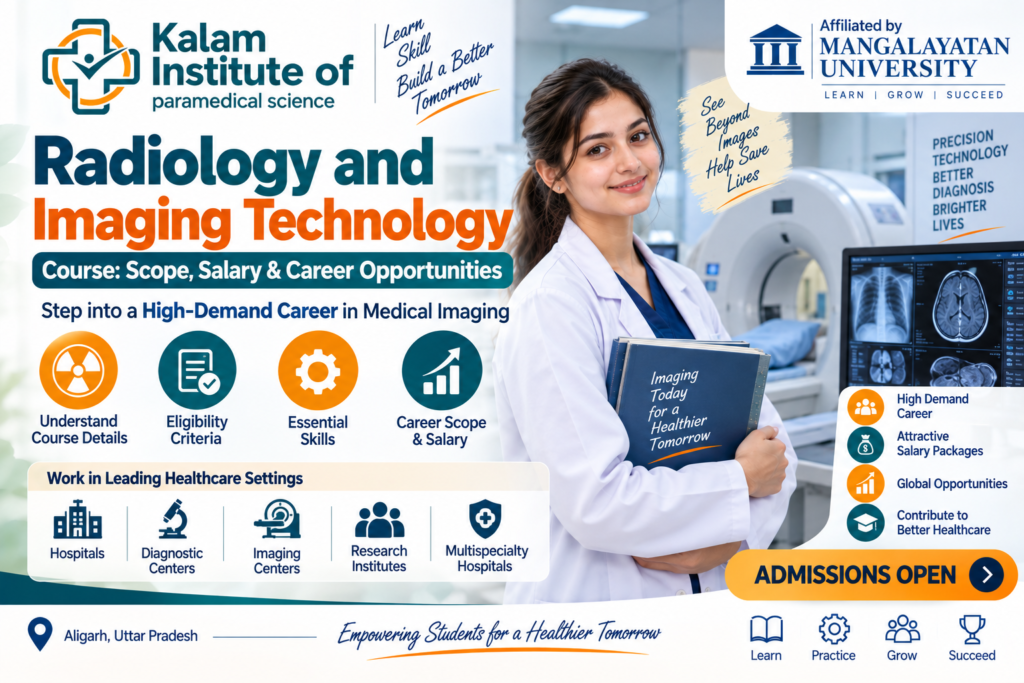
If you are interested in healthcare, medical technology, and practical technical work, a Radiology and Imaging Technology Course can be an exciting career option after Class 12.
Mangalayatan University offers programs in Medical Radiology & Imaging Technology through its paramedical education offerings. Its current 2026–27 admission information includes a B.Sc. Medical Radiology & Imaging Technology program as well as an advanced diploma pathway. (mangalayatan.in)
This guide explains the course, eligibility, subjects, career scope, salary factors, job opportunities, skills, higher-study options, and future prospects in radiology and medical imaging.
What Is Radiology and Imaging Technology?
Radiology and Imaging Technology is an allied healthcare field focused on the use of medical imaging equipment and techniques to produce images of the internal structures of the human body.
Medical imaging can help healthcare professionals examine areas such as:
- Bones
- Organs
- Soft tissues
- Blood vessels
- Muscles
- Internal structures
- Certain abnormalities and injuries
Depending on their training and workplace, imaging professionals may work with technologies such as:
- X-ray
- Computed Tomography (CT)
- Magnetic Resonance Imaging (MRI)
- Fluoroscopy
- Mammography
- Other specialized imaging systems
The role of an imaging professional is primarily technical and patient-support oriented. Interpretation of diagnostic images and clinical diagnosis are performed by appropriately qualified healthcare professionals within their scope of practice.
What Does a Radiology and Imaging Technician Do?
The day-to-day responsibilities of an imaging professional can vary according to their qualification, specialization, and workplace.
Typical responsibilities may include:
- Preparing patients for imaging procedures
- Explaining basic procedure-related instructions
- Positioning patients correctly
- Operating appropriate imaging equipment
- Following radiation-safety procedures
- Maintaining patient and examination records
- Checking image quality
- Following infection-control procedures
- Supporting radiologists and other healthcare professionals
- Maintaining a safe imaging environment
Accuracy is extremely important because the quality of an image can affect the usefulness of the examination.
Why Choose Radiology and Imaging Technology?
Medical imaging combines healthcare, science, and technology, making it attractive to students who enjoy all three areas.
1. Work With Advanced Medical Technology
Radiology professionals work with sophisticated equipment used in modern diagnostic healthcare.
2. Practical Career
The field involves hands-on procedures, patient positioning, equipment operation, and clinical workflow.
3. Multiple Specializations
With suitable training, professionals can develop expertise in different imaging technologies.
4. Healthcare Environment
Graduates can explore opportunities in hospitals, diagnostic centres, imaging facilities, and other healthcare organizations.
5. Scope for Professional Development
Additional education, specialized training, and experience can help professionals progress toward more advanced technical or supervisory roles.
Eligibility for Radiology and Imaging Technology Course
Eligibility depends on the specific institution and program.
For the current 2026–27 B.Sc. Medical Radiology & Imaging Technology program, Mangalayatan University lists:
- 10+2 or equivalent qualification
- PCB/PCM background
- Minimum 50% aggregate marks
- Minimum age of 17 years on December 31 of the admission year
The university also lists an Advanced Diploma in Medical Radiology & Imaging Technology, with 10+2 and a minimum 50% aggregate in PCB/PCM as the current eligibility requirement. (mangalayatan.in)
Since admission requirements may change, students should always check the latest official notification before applying.
Eligibility at a Glance
Requirement | B.Sc. Medical Radiology & Imaging Technology |
Qualification | 10+2 or equivalent |
Science subjects | PCB/PCM |
Minimum marks | 50% |
Course duration | 3 years + internship |
Minimum age | 17 years* |
*Based on the current 2026–27 admission information.
Course Duration
The duration depends on the qualification you choose.
Mangalayatan University currently lists:
B.Sc. Medical Radiology & Imaging Technology: 3 years + internship
Advanced Diploma in Medical Radiology & Imaging Technology: 2 years
A degree course may be more appropriate for students seeking a broader undergraduate education, while an advanced diploma can provide a shorter specialized route.
Subjects in Radiology and Imaging Technology
The curriculum can vary between institutions, but students generally study a combination of medical sciences, imaging technology, patient care, and safety.
Human Anatomy
Students learn about the structure of the human body and the location of different organs, bones, tissues, and systems.
Anatomical knowledge is particularly important for patient positioning and understanding medical images.
Physiology
Physiology helps students understand how different organs and body systems function.
Radiographic Techniques
Students learn the basic principles and procedures involved in producing radiographic images.
Radiation Physics
Radiation physics introduces the scientific principles behind X-rays and other radiation-based imaging technologies.
Radiation Protection
Safety is a major component of radiology education. Students learn how to minimize unnecessary radiation exposure and follow established safety protocols.
Imaging Equipment
Students become familiar with imaging equipment, its basic operation, safety features, and maintenance considerations.
Patient Care
Imaging professionals interact directly with patients. They need to understand patient preparation, positioning, communication, and basic care procedures.
Medical Ethics
Students also learn the importance of patient confidentiality, dignity, professional conduct, and ethical healthcare practices.
Practical Training in Radiology
Radiology is not a field that can be learned entirely from textbooks.
Practical exposure helps students become familiar with the real workflow of an imaging department.
Training may involve:
- Patient positioning
- Equipment handling
- Imaging procedures
- Radiation protection
- Image-quality assessment
- Patient communication
- Infection control
- Clinical documentation
- Equipment-care practices
Practical training also helps students develop confidence when working in hospitals and diagnostic centres.
Career Scope in Radiology and Imaging Technology
The scope of radiology and imaging technology extends across several healthcare environments.
Qualified professionals may explore opportunities in:
- Government hospitals
- Private hospitals
- Diagnostic centres
- Imaging centres
- Specialty hospitals
- Trauma centres
- Clinics
- Research institutions
- Medical colleges
- Healthcare organizations
The specific job opportunities available depend on the candidate’s qualification, specialization, experience, and employer requirements.
Career Opportunities After Radiology Course
A qualification in Radiology and Imaging Technology can lead to several technical healthcare roles.
1. Radiology Technician
Radiology technicians assist with diagnostic imaging procedures and operate relevant equipment within their training and professional scope.
2. Radiographer
Radiographers are trained professionals involved in producing diagnostic images using appropriate imaging technologies.
3. X-Ray Technician
X-ray technicians perform radiographic procedures, prepare patients, position them appropriately, and operate X-ray equipment according to established protocols.
4. CT Technician
Professionals with appropriate specialized training can work with Computed Tomography equipment.
CT uses X-rays and computer processing to create detailed cross-sectional images of the body.
5. MRI Technician
MRI technicians work with magnetic resonance imaging systems.
MRI uses magnetic fields and radio waves rather than ionizing radiation to produce detailed images.
6. Imaging Centre Technician
Diagnostic imaging centres employ trained technical professionals to support their day-to-day imaging services.
7. Mammography Technician
Professionals with appropriate specialized training can work in mammography services and support breast-imaging procedures.
Specialized certification or training may be required for particular roles.
Where Can Radiology Professionals Work?
Radiology and imaging professionals can work in various healthcare settings.
Hospitals
Hospitals have imaging departments that support emergency, outpatient, inpatient, surgical, and specialty services.
Diagnostic Centres
Diagnostic centres offer imaging services to patients referred for medical examinations.
Specialty Hospitals
Hospitals specializing in areas such as orthopaedics, cardiology, neurology, oncology, or other medical fields may have dedicated imaging departments.
Trauma Centres
Emergency and trauma facilities often rely on imaging to support the assessment of injuries.
Research Institutions
Professionals with suitable qualifications may also explore research-related technical roles.
Radiology Technician Salary in India
Salary is one of the most frequently searched topics by students considering a radiology career.
However, there is no single fixed salary for every radiology technician.
Income can vary considerably based on:
- Educational qualification
- Work experience
- Specialization
- Employer
- City
- Type of healthcare facility
- Technical skills
- Additional certifications
- Job responsibilities
A fresh graduate may start in an entry-level position, while an experienced professional with specialized imaging skills may qualify for more senior positions.
For this reason, students should treat online salary figures as general estimates rather than guaranteed earnings.
Factors That Can Influence Salary
Qualification:
A relevant degree can provide a broader academic foundation.
Experience:
Practical experience often influences career progression and compensation.
Specialization:
Advanced skills in areas such as CT or MRI can create additional career opportunities.
Location:
Salaries can vary between cities and regions.
Employer:
Government institutions, corporate hospitals, private hospitals, diagnostic chains, and specialty centres may have different salary structures.
Skills:
Technical proficiency, communication, safety awareness, and professional experience can influence employability.
Government Jobs After Radiology Course
Qualified candidates may explore government healthcare employment when suitable vacancies are announced.
Potential workplaces can include:
- Government hospitals
- Public healthcare institutions
- Government medical colleges
- Research institutions
- Defence healthcare facilities
- State healthcare departments
However, completing a radiology course does not automatically guarantee a government job.
Candidates must meet the specific eligibility requirements and recruitment conditions for each position.
Private Jobs After Radiology Course
The private healthcare sector offers many potential employment environments.
Graduates may explore positions in:
- Private hospitals
- Corporate hospitals
- Diagnostic chains
- Imaging centres
- Specialty clinics
- Trauma facilities
- Healthcare organizations
Professionals can potentially increase their career options by gaining experience and developing specialized imaging skills.
Skills Required for a Successful Radiology Career
Technical education is only one part of becoming a successful imaging professional.
Attention to Detail
Correct patient positioning and accurate procedure execution are essential for useful imaging.
Technical Skills
Professionals need to understand imaging equipment and follow appropriate operating procedures.
Patient Communication
Patients may feel nervous about imaging procedures. Clear and respectful communication can help create a more comfortable experience.
Radiation Safety Awareness
Professionals working with ionizing radiation must follow established safety procedures carefully.
Teamwork
Imaging departments work closely with radiologists, doctors, nurses, and other healthcare professionals.
Time Management
Busy hospitals and diagnostic centres may handle many examinations in a day. Efficient workflow is important.
Problem-Solving
Professionals may encounter equipment, positioning, or workflow challenges and need to respond appropriately within their training and workplace procedures.
Radiology Technician vs Radiologist
This is an important distinction for students.
A radiologist is a medical doctor who specializes in interpreting medical images and providing radiological diagnosis as part of medical practice.
A radiology technician/radiographer is a trained allied healthcare professional who performs or assists with imaging procedures and operates relevant equipment within their professional scope.
In simple terms:
Radiologist = Medical doctor specializing in radiology
Radiology Technician/Radiographer = Imaging technology professional
Both work together, but their education and professional responsibilities are different.
Higher Studies After Radiology
Students can continue their education after completing an appropriate radiology qualification.
Depending on their existing qualification and eligibility, options may include:
- Advanced diploma programs
- Bachelor’s degree programs
- Specialized CT training
- MRI specialization
- Other imaging certifications
- Postgraduate healthcare programs
- Healthcare management courses
Additional education can help professionals develop specialized knowledge and prepare for more advanced career opportunities.
Career Growth in Radiology and Imaging Technology
Radiology offers a career path that can develop gradually through education, specialization, and experience.
A possible progression may look like:
Trainee → Junior Technician → Radiology Technician → Senior Technician → Specialized Imaging Technician → Supervisor
The actual career progression varies between organizations and individuals.
Professionals who develop expertise in advanced imaging technologies may be able to pursue more specialized roles.
Why Study Radiology and Imaging Technology at Mangalayatan University?
Mangalayatan University offers Medical Radiology & Imaging Technology programs through its paramedical education offerings.
Its current 2026–27 admission information includes a B.Sc. Medical Radiology & Imaging Technology program as well as an advanced diploma option. (mangalayatan.in)
The university’s information highlights medical imaging education covering areas such as radiology, diagnostic imaging, and related technical skills. Its paramedical education also emphasizes practical learning and healthcare exposure. (mangalayatan.in)
Students comparing radiology colleges should consider:
- Course curriculum
- Faculty
- Imaging and laboratory facilities
- Practical training
- Clinical exposure
- Internship opportunities
- Course duration
- Eligibility
- Fees
- Career support
- Higher education options
The best institution is one that provides a strong balance between theoretical knowledge and practical skills.
How to Choose the Right Radiology Course
Before taking admission, consider the following.
1. Understand the Qualification
Decide whether a degree or diploma better fits your educational and career goals.
2. Check Eligibility
Confirm the latest requirements regarding Class 12 subjects, minimum marks, and other admission conditions.
3. Examine Practical Training
Radiology is a technical field, so practical exposure should be an important consideration.
4. Check Available Facilities
Look for appropriate laboratories, imaging facilities, simulation resources, and clinical exposure.
5. Understand the Internship
Find out where and how practical or internship training is provided.
6. Consider Future Specialization
If you are interested in CT, MRI, mammography, or other imaging technologies, consider how you can develop those skills after the initial qualification.
Is Radiology and Imaging Technology a Good Career?
Radiology and Imaging Technology can be a good career option for students who are interested in science, healthcare, technology, and practical work.
It can be particularly suitable if you:
- Enjoy science subjects
- Like working with technology
- Have good attention to detail
- Are comfortable working in hospitals
- Enjoy practical learning
- Can communicate professionally with patients
- Take safety procedures seriously
The profession requires continuous learning because medical imaging technology continues to evolve.
Frequently Asked Questions
What is a Radiology and Imaging Technology course?
It is an allied healthcare program that prepares students to work with medical imaging technologies and support diagnostic imaging services.
Can I pursue Radiology after 12th?
Yes. Students who meet the required science-subject and minimum-mark criteria can apply for eligible radiology and imaging programs.
What is the eligibility for B.Sc. Medical Radiology & Imaging Technology at Mangalayatan University?
For the current 2026–27 admission cycle, Mangalayatan University lists 10+2 with PCB/PCM and at least 50% aggregate marks, with a minimum age of 17 years on December 31 of the admission year. (mangalayatan.in)
How long is the B.Sc. Medical Radiology & Imaging Technology course?
Mangalayatan University’s current information lists the B.Sc. program as three years plus internship. (mangalayatan.in)
What jobs are available after a radiology course?
Depending on qualification and specialization, graduates may explore roles such as Radiology Technician, Radiographer, X-Ray Technician, CT Technician, MRI Technician, and Imaging Technician.
What is the salary of a radiology technician?
Salary varies according to qualification, experience, specialization, location, employer, and job responsibilities. There is no single salary applicable to every radiology technician.
Is MRI better than X-ray as a career?
Neither is universally better. X-ray and MRI involve different technologies, skills, work environments, and training requirements. Students should choose based on their interests and long-term career goals.
Can I work in a government hospital after a radiology course?
Eligible candidates can apply for government positions when relevant vacancies are available and when they meet the recruitment requirements.
Can I study further after Radiology and Imaging Technology?
Yes. Depending on your existing qualification and eligibility, you can pursue higher education, advanced diplomas, specialized imaging training, certifications, or related healthcare programs.
Conclusion
A Radiology and Imaging Technology Course offers students an opportunity to build a career at the intersection of healthcare, science, and technology.
From X-rays and CT scans to MRI and other imaging technologies, diagnostic imaging has become an important part of modern healthcare. Trained imaging professionals contribute by preparing patients, operating equipment, following safety procedures, and producing technically appropriate images for clinical interpretation.
Career opportunities can be found across hospitals, diagnostic centres, imaging facilities, specialty hospitals, trauma centres, and other healthcare organizations.
Mangalayatan University’s current offerings include B.Sc. Medical Radiology & Imaging Technology and an advanced diploma pathway, giving students different options for entering this specialized area of allied healthcare. (mangalayatan.in)
If you are a Class 12 student interested in medical technology and diagnostic imaging, radiology may be worth considering as a long-term career option.
Before enrolling, compare the curriculum, practical exposure, facilities, internship opportunities, eligibility, fees, and future education options. A well-chosen course can provide the foundation for developing the technical knowledge and professional skills needed for a career in medical imaging.