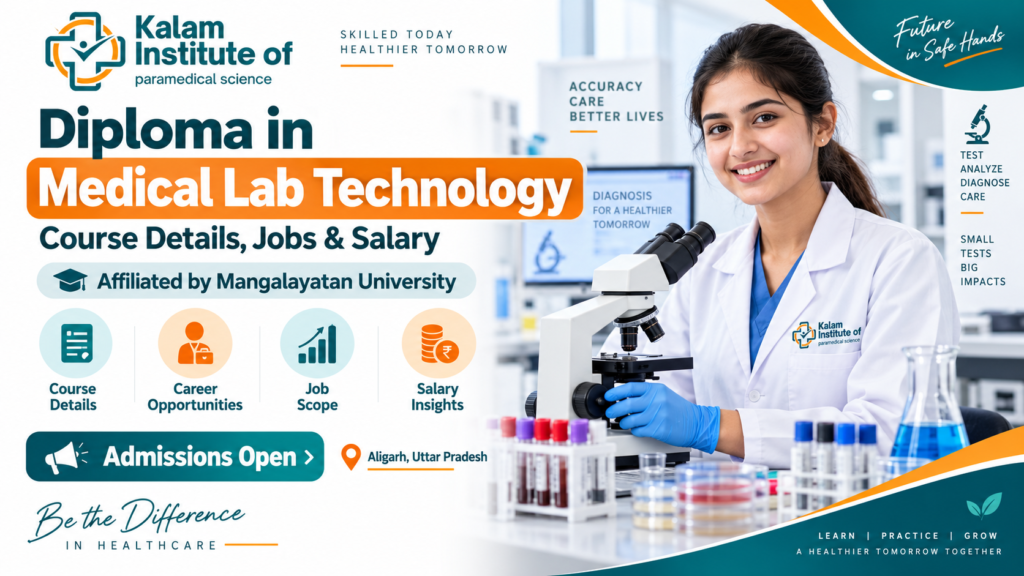
The healthcare industry depends not only on doctors and nurses but also on skilled laboratory professionals who help in disease detection, diagnosis, testing, and patient monitoring.
One of the most popular career-oriented options for students interested in laboratory science is the Diploma in Medical Lab Technology, commonly known as DMLT.
This program is suitable for students who want to enter the healthcare sector through a practical, technical, and skill-based course. It introduces students to laboratory testing, sample handling, pathology, microbiology, biochemistry, hematology, and other important areas of medical diagnostics.
Students looking for a healthcare career after 12th can explore DMLT and related paramedical programs through institutes affiliated with Mangalayatan University, depending on current course availability, eligibility, and academic requirements.
This guide explains the course details, eligibility, syllabus, career opportunities, jobs, salary expectations, skills, and future scope of DMLT in simple terms.
What Is Diploma in Medical Lab Technology?
The Diploma in Medical Lab Technology, or DMLT, is a paramedical course that focuses on laboratory testing and diagnostic procedures used in healthcare.
Medical laboratory professionals assist in examining samples such as:
- Blood
- Urine
- Tissue
- Sputum
- Body fluids
- Other clinical specimens
These tests help doctors and healthcare professionals understand a patient’s medical condition.
Students studying DMLT learn how laboratories operate, how samples are handled, how testing procedures are performed, how reports are prepared, and how laboratory safety is maintained.
Why Choose DMLT After 12th?
Students interested in science, diagnostics, laboratories, and healthcare technology may find DMLT a practical career option.
Some reasons students choose this field include:
Entry Into the Healthcare Industry
DMLT can provide a pathway into hospitals, pathology laboratories, diagnostic centres, and healthcare organizations.
Practical Learning
The course generally focuses strongly on laboratory procedures and technical skills.
Multiple Career Opportunities
Graduates may explore different job roles in diagnostic and clinical laboratory settings.
Opportunity for Higher Education
After completing a relevant diploma, students may continue toward higher education depending on eligibility.
Healthcare Demand
Diagnostic testing is an important part of modern healthcare, which makes trained laboratory professionals valuable in hospitals and diagnostic facilities.
DMLT Full Form
DMLT stands for:
Diploma in Medical Laboratory Technology
The course is designed to train students in laboratory techniques used for diagnostic purposes.
DMLT Course Duration
The duration of a Diploma in Medical Lab Technology can vary depending on the institution and academic structure.
In many cases, diploma programs may be completed within approximately one to two years, though the exact duration can differ.
Some programs may also include practical training, laboratory sessions, or internship components.
Students should confirm the official duration directly with the institution before admission.
DMLT Course Eligibility
Eligibility requirements vary according to the university or institute.
Common requirements may include:
- Completion of Class 12 from a recognized board
- Science stream in many cases
- Physics, Chemistry, Biology, or other required subjects
- Minimum qualifying marks
- Age criteria where applicable
- Required academic documents
Some institutions may have different admission rules.
Students should always verify the official eligibility criteria for the specific DMLT program they plan to join.
Can You Do DMLT After 12th?
Yes.
Students who have completed Class 12 and meet the required eligibility criteria can explore DMLT programs.
Students from a science background may be especially suitable for this field because the course involves biology, pathology, microbiology, and laboratory science.
Can You Do DMLT Without NEET?
In many institutions, DMLT admission may not require NEET.
However, admission requirements can vary between universities and colleges.
Students should confirm whether:
- NEET is required
- Merit-based admission is available
- An institute-level entrance test is required
- Direct admission is available
Do not assume the same admission process applies everywhere.
DMLT Course Subjects
The DMLT syllabus generally includes a combination of theory and practical learning.
The exact subjects depend on the university and course structure.
Some commonly studied areas may include:
Human Anatomy
Students learn about the structure of the human body.
This includes organs, tissues, bones, muscles, and body systems.
Human Physiology
Physiology explains how different organs and body systems function.
This subject helps students understand how laboratory values relate to normal and abnormal body processes.
Pathology
Pathology focuses on diseases and the changes they create in the body.
Students may learn basic concepts related to disease diagnosis and laboratory examination.
Hematology
Hematology is related to blood and blood disorders.
Students may learn about:
- Blood cells
- Hemoglobin
- Blood grouping
- Complete blood count concepts
- Coagulation basics
- Sample handling
Clinical Biochemistry
Clinical biochemistry focuses on chemical components in the body.
Students may learn about tests involving:
- Blood sugar
- Liver function
- Kidney function
- Lipids
- Proteins
- Enzymes
Microbiology
Microbiology introduces students to microorganisms such as:
- Bacteria
- Viruses
- Fungi
- Parasites
Students may study infection, sample processing, and basic laboratory techniques.
Clinical Pathology
Clinical pathology may involve examination of blood, urine, and other clinical specimens.
Students learn how laboratory findings can support diagnosis.
Laboratory Techniques
Students may develop knowledge related to:
- Sample collection
- Sample labeling
- Testing procedures
- Laboratory instruments
- Record keeping
- Safety protocols
- Quality control
Infection Control
Students learn about hygiene and methods used to reduce the risk of contamination.
This is especially important in laboratories handling biological samples.
Medical Terminology
Understanding healthcare terminology helps students communicate effectively with doctors, technicians, nurses, and other healthcare professionals.
DMLT Practical Training
Practical training is one of the most important parts of medical laboratory education.
A good laboratory professional needs both theoretical knowledge and hands-on skills.
Students may receive practical exposure in areas such as:
- Blood sample handling
- Urine testing
- Microscopy
- Basic staining methods
- Laboratory equipment
- Sample storage
- Safety procedures
- Report preparation
- Quality control
- Laboratory documentation
Practical learning helps students understand how a real diagnostic laboratory functions.
Internship in DMLT
Some DMLT programs may include an internship or supervised practical training.
Internships can provide exposure to:
- Hospitals
- Pathology labs
- Diagnostic centres
- Clinical laboratories
- Healthcare facilities
During internship training, students may observe or assist with routine laboratory procedures under supervision.
Students should ask whether an internship is included before taking admission.
Skills Required for DMLT Students
A career in medical laboratory technology requires both technical knowledge and professional discipline.
Students should develop the following skills:
Attention to Detail
Laboratory work requires accuracy.
A small mistake in sample labeling or documentation can create serious confusion.
Observation Skills
Students should be able to notice small differences during testing and sample examination.
Technical Skills
Laboratory professionals work with different instruments and testing procedures.
Comfort with equipment is important.
Communication Skills
Technicians often communicate with doctors, nurses, patients, and laboratory staff.
Time Management
Hospitals and diagnostic centres may handle many samples each day.
Good time management helps maintain efficiency.
Hygiene and Safety Awareness
Laboratories may handle infectious or hazardous biological materials.
Following safety protocols is essential.
Professional Ethics
Patient information must be handled confidentially and responsibly.
Career Opportunities After DMLT
After completing a DMLT program, students may explore jobs in different healthcare settings.
Career opportunities depend on the qualification, skills, employer requirements, experience, and applicable professional regulations.
Possible job areas include:
- Hospitals
- Diagnostic centres
- Pathology laboratories
- Blood banks
- Healthcare clinics
- Research laboratories
- Medical laboratories
- Public health laboratories
- Healthcare organizations
Jobs After Diploma in Medical Lab Technology
Graduates may explore job roles such as:
Medical Laboratory Technician
A medical laboratory technician may assist with routine laboratory tests and sample processing.
Laboratory Assistant
Laboratory assistants support day-to-day laboratory operations.
Pathology Lab Technician
These professionals work in pathology-related testing environments.
Sample Collection Technician
Some roles may involve sample collection and preparation, depending on training and employer requirements.
Clinical Laboratory Assistant
Clinical laboratory assistants support laboratory testing and documentation.
Diagnostic Lab Technician
Diagnostic lab technicians may work in private or hospital-based testing centres.
Blood Bank Technician
Depending on qualification and applicable requirements, some professionals may work in blood-bank-related roles.
Research Lab Assistant
Students with appropriate skills may explore supporting roles in medical or healthcare research laboratories.
DMLT Salary in India
Salary after DMLT can vary significantly.
There is no fixed salary for every graduate.
Income depends on factors such as:
- City
- Employer
- Experience
- Skill level
- Type of laboratory
- Shift timing
- Additional qualifications
- Job responsibilities
Entry-level professionals may begin with modest salaries and grow with experience.
Private hospitals, diagnostic chains, specialized laboratories, and larger cities may offer different pay levels compared with smaller facilities.
Students should avoid relying on exaggerated salary claims and focus instead on skill development and practical experience.
What Is the Starting Salary After DMLT?
Starting salary varies depending on location and employer.
Freshers may receive entry-level pay according to the organization’s salary structure.
A candidate with strong practical knowledge, good communication, and additional certification may have better employment prospects.
The salary can gradually increase with experience and specialization.
Factors That Affect DMLT Salary
Several factors influence earnings.
Experience
Professionals with more experience generally have stronger earning potential.
Location
Salary levels may be higher in larger cities, though living costs may also be higher.
Employer
Large hospitals or established diagnostic laboratories may offer different compensation structures than smaller labs.
Skills
Candidates who are comfortable with advanced laboratory equipment and procedures may have an advantage.
Further Education
Higher qualifications may open the door to more advanced roles.
Government Jobs After DMLT
Depending on vacancies, eligibility, recruitment rules, and qualification recognition, DMLT graduates may explore government healthcare opportunities.
Potential employers may include:
- Government hospitals
- Public health departments
- District hospitals
- Medical colleges
- Public diagnostic laboratories
- Health missions
- Research organizations
Government jobs generally require candidates to meet specific eligibility conditions and pass the applicable recruitment process.
Students should always check official government notifications.
Private Jobs After DMLT
Private healthcare is a major employment area for laboratory professionals.
Graduates may explore opportunities in:
- Multi-specialty hospitals
- Diagnostic chains
- Pathology laboratories
- Private clinics
- Corporate hospitals
- Health check-up centres
- Medical laboratories
Private-sector growth can depend on skills, experience, and performance.
Higher Education After DMLT
Students who want to continue studying may explore higher education depending on eligibility.
Possible options can include:
- Bachelor’s programs in Medical Laboratory Technology
- Allied health science programs
- Laboratory science programs
- Healthcare management
- Hospital administration
- Advanced laboratory certifications
- Specialized diagnostic programs
Higher education can help students develop deeper knowledge and improve long-term career opportunities.
DMLT vs BMLT
Students often compare DMLT and BMLT.
DMLT
DMLT is a diploma-level program.
It generally focuses on practical laboratory skills and may have a shorter duration.
BMLT
BMLT is a bachelor’s-level program.
It usually provides a broader and more detailed academic understanding of medical laboratory technology.
Students who want faster skill-based training may consider a diploma pathway.
Students interested in deeper study and long-term academic growth may explore a bachelor’s degree.
The better choice depends on career goals, eligibility, time, and budget.
Is DMLT a Good Career?
DMLT can be a suitable healthcare career option for students who enjoy:
- Laboratory work
- Biology
- Diagnostic testing
- Healthcare
- Medical technology
- Technical procedures
It can offer opportunities in hospitals and diagnostic settings.
However, career growth depends on genuine skills, experience, higher education, and professional development.
Scope of DMLT in India
Diagnostic testing plays an important role in healthcare.
Doctors often rely on laboratory reports to understand a patient’s medical condition.
As healthcare services expand, laboratories and diagnostic centres continue to remain important.
The scope of DMLT can include work in:
- Clinical diagnostics
- Pathology
- Microbiology
- Hematology
- Biochemistry
- Blood banking
- Research support
- Healthcare laboratories
Professionals who continuously upgrade their skills may improve their career prospects over time.
Why Study DMLT in Aligarh?
Students from Aligarh and nearby locations may prefer studying locally.
Choosing a paramedical institute in Aligarh may provide benefits such as:
- Reduced relocation expenses
- Convenient travel
- Family support
- Local education opportunities
- Practical healthcare learning
- Career-oriented training
Students should compare institutions based on academic quality rather than choosing only by distance.
Why Choose an Institute Affiliated with Mangalayatan University?
University affiliation is an important factor when selecting a paramedical program.
Students considering a DMLT or related healthcare course through an institute affiliated with Mangalayatan University should verify the current academic status of the exact program before admission.
Important points to check include:
- Exact course name
- Duration
- Eligibility
- Curriculum
- Examination process
- Practical training
- Internship
- Qualification awarded
- Current affiliation
- Career scope
This helps students make an informed decision about their education.
What to Check Before Taking DMLT Admission
Before taking admission, students should ask:
- What is the exact course name?
- What is the duration?
- What are the eligibility criteria?
- Is the course currently affiliated?
- Which university is the institute affiliated with?
- What subjects are included?
- Is practical training available?
- Is internship included?
- What laboratory equipment is available?
- What qualification will I receive?
- What jobs can I apply for?
- Is any professional registration required?
- What is the complete fee structure?
- What higher education options are available?
Students should obtain clear information before paying admission fees.
Who Should Choose DMLT?
DMLT may be suitable for students who:
- Are interested in science
- Enjoy laboratory work
- Want to enter healthcare
- Prefer practical learning
- Are comfortable with medical equipment
- Have good attention to detail
- Can follow safety procedures
- Want a technical healthcare career
Frequently Asked Questions
What is DMLT?
DMLT stands for Diploma in Medical Laboratory Technology. It is a paramedical program focused on clinical laboratory testing, sample handling, and diagnostic procedures.
Can I do DMLT after 12th?
Yes. Students who meet the eligibility criteria can pursue DMLT after Class 12.
Is NEET required for DMLT?
Many DMLT programs may not require NEET, but admission rules vary. Students should verify the official requirements of the selected institute or university.
What is the duration of DMLT?
The duration can vary depending on the institution and course structure. Students should confirm the exact duration before admission.
What jobs can I get after DMLT?
Graduates may explore roles such as Medical Laboratory Technician, Laboratory Assistant, Pathology Lab Technician, Diagnostic Lab Technician, and Clinical Laboratory Assistant.
What is the salary after DMLT?
Salary depends on location, experience, employer, qualifications, and skills. Freshers usually start at entry-level pay and can earn more with experience.
Is DMLT a good career after 12th?
DMLT can be a good option for students interested in laboratories, diagnostic testing, healthcare, and medical technology.
Can DMLT graduates work in hospitals?
Yes. Depending on qualifications and employer requirements, graduates may work in hospitals, pathology labs, diagnostic centres, and clinical laboratories.
Can I study further after DMLT?
Yes. Depending on eligibility, students may pursue degree-level medical laboratory technology, allied health programs, healthcare management, or other related studies.
Is DMLT suitable for science students?
Yes. Students from a science background may find DMLT especially relevant because the course involves biology, pathology, microbiology, and laboratory science.
Where can I study DMLT in Aligarh?
Students can explore paramedical and healthcare programs offered by institutes in Aligarh, including programs through institutes affiliated with Mangalayatan University, subject to current course availability and eligibility.
Conclusion
The Diploma in Medical Lab Technology can be a practical career option for students who want to enter the healthcare industry through laboratory science and diagnostic testing.
The course introduces students to important areas such as pathology, hematology, microbiology, biochemistry, sample handling, laboratory equipment, safety, and healthcare documentation.
After completing the relevant qualification, students may explore opportunities in hospitals, diagnostic centres, pathology laboratories, healthcare clinics, and other medical organizations.
Career growth depends on practical skills, professional knowledge, experience, higher education, and employer requirements.
Students looking for a DMLT or related paramedical course in Aligarh can explore programs through institutes affiliated with Mangalayatan University, subject to current affiliation, eligibility, course structure, and academic requirements.
Before admission, always verify the exact course details, duration, practical training, internship opportunities, qualification awarded, career scope, and any applicable professional requirements.
With the right training and a strong focus on practical skills, DMLT students can build a solid foundation for a career in medical diagnostics and the wider healthcare sector.
Explore Diploma in Medical Lab Technology and other healthcare career courses affiliated with Mangalayatan University and take your first step toward a professional career in medical diagnostics.