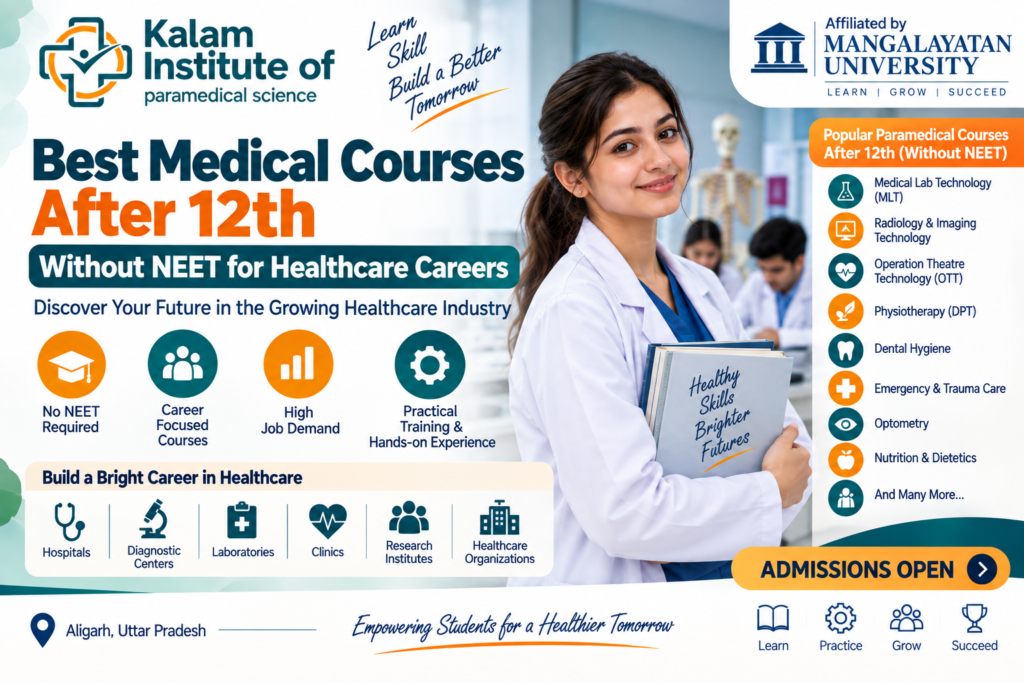
Best Medical Courses After 12th Without NEET for Healthcare Careers | Affiliated by Mangalayatan University
For many students in India, building a career in healthcare is a dream. However, not every student wants to pursue MBBS or appear for NEET. The good news is that the healthcare industry offers many career-oriented courses that can be studied after Class 12 without following the traditional MBBS route.
Students searching for the best medical courses after 12th without NEET can explore several paramedical, allied health, diagnostic, laboratory, imaging, and patient-care programs.
These courses can help students build practical healthcare skills and prepare for opportunities in hospitals, diagnostic centres, laboratories, clinics, rehabilitation centres, and other medical organizations.
Students in Aligarh and nearby areas can also explore healthcare career programs through institutes affiliated with Mangalayatan University, depending on the current courses offered, eligibility criteria, and academic requirements.
This guide explains some of the most popular healthcare career options after 12th that may not require NEET for admission.
Can You Build a Healthcare Career Without NEET?
Yes.
NEET is primarily associated with admission to specific medical and dental programs such as MBBS, BDS, and certain other regulated courses.
However, the healthcare sector is much broader than becoming a doctor.
Hospitals and medical organizations require trained professionals in areas such as:
- Medical laboratory technology
- Radiology
- Diagnostic imaging
- Operation theatre technology
- Patient care
- Healthcare assistance
- Medical equipment handling
- Emergency support
- Rehabilitation
- Clinical laboratory services
- Allied health sciences
Many of these programs may have separate admission criteria and may not require NEET.
Students should still verify the exact eligibility and admission requirements for the specific course and university before applying.
Why Choose Medical Courses After 12th Without NEET?
There are several reasons why students explore healthcare courses without NEET.
More Career Options
Healthcare careers are not limited to doctors.
A modern hospital needs a complete team of trained professionals to support diagnosis, treatment, patient care, technology, and administration.
Students can choose a specialization based on their interests and skills.
Skill-Based Learning
Many paramedical and allied healthcare courses focus strongly on practical learning.
Students may learn how to use medical equipment, handle laboratory procedures, support patient care, assist healthcare teams, and understand clinical processes.
Faster Entry Into the Healthcare Sector
Depending on the program selected, students may be able to complete their education in a shorter period than a traditional medical degree.
This can help them enter the healthcare industry earlier.
Growing Healthcare Industry
India’s healthcare sector includes:
- Government hospitals
- Private hospitals
- Diagnostic centres
- Pathology laboratories
- Imaging centres
- Specialty clinics
- Rehabilitation facilities
- Medical technology companies
- Healthcare startups
As this sector grows, trained healthcare support professionals remain important.
Best Medical Courses After 12th Without NEET
Students can explore several career-oriented healthcare programs after completing Class 12.
The exact eligibility depends on the institution, university, subjects studied in Class 12, and the type of program.
Here are some popular options.
1. Medical Laboratory Technology
Medical laboratory technology is one of the most popular healthcare fields for students interested in science and laboratory work.
Laboratory professionals help doctors by performing or supporting diagnostic tests on blood, urine, tissue, and other samples.
Students may study subjects such as:
- Clinical pathology
- Hematology
- Microbiology
- Biochemistry
- Human anatomy
- Physiology
- Sample collection
- Laboratory safety
- Medical terminology
- Laboratory equipment
Career Opportunities
Depending on the qualification, students may explore roles such as:
- Medical Laboratory Technician
- Laboratory Assistant
- Pathology Lab Assistant
- Diagnostic Lab Technician
- Clinical Laboratory Assistant
Employment opportunities may be available in hospitals, pathology laboratories, diagnostic centres, and medical laboratories.
2. Radiology and Medical Imaging Technology
Radiology and medical imaging are important areas of modern healthcare.
Doctors use diagnostic imaging to examine internal structures of the body and identify medical conditions.
Students studying medical imaging may learn about:
- Patient positioning
- Imaging equipment
- Anatomy
- Imaging procedures
- Radiation safety
- Healthcare documentation
- Medical terminology
- Patient preparation
Career Opportunities
Depending on qualifications and professional requirements, graduates may explore roles such as:
- Radiology Technician
- Imaging Technician
- Radiology Assistant
- Diagnostic Imaging Assistant
- Medical Imaging Technician
These professionals may work in hospitals, diagnostic centres, imaging clinics, and other healthcare settings.
3. Ultrasound-Related Medical Imaging Courses
Ultrasound technology is another area that attracts students interested in diagnostic imaging.
Students may learn about:
- Basic ultrasound principles
- Anatomy
- Physiology
- Medical imaging concepts
- Patient preparation
- Equipment handling
- Clinical procedures
However, students should understand that ultrasound practice in India is regulated.
Completing an ultrasound-related or paramedical course does not automatically give a student the legal authority to independently perform, interpret, or report all ultrasound examinations.
The exact professional scope depends on qualifications, applicable laws, registrations, and healthcare regulations.
Students should verify this carefully before taking admission.
4. Operation Theatre Technology
Operation theatre professionals support surgical teams before, during, and after procedures.
Students interested in hospital environments and surgical care may consider operation theatre technology.
Subjects can include:
- Operation theatre preparation
- Surgical instruments
- Sterilization
- Infection control
- Patient preparation
- Basic surgical procedures
- Healthcare safety
- Hospital protocols
Career Opportunities
Graduates may explore roles such as:
- Operation Theatre Technician
- OT Assistant
- Surgical Support Technician
- Theatre Assistant
These positions may be available in hospitals, surgical centres, and specialty clinics.
5. Patient Care Assistant Courses
Patient care is an important part of healthcare services.
Patient care professionals support patients under appropriate supervision and help with day-to-day healthcare needs.
Students may learn:
- Basic patient care
- Hygiene
- Patient communication
- Healthcare safety
- Patient positioning
- Basic documentation
- Hospital procedures
- Professional conduct
Career Opportunities
Possible roles may include:
- Patient Care Assistant
- Healthcare Assistant
- Hospital Support Assistant
- Clinical Support Staff
- Care Assistant
This field can be suitable for students who enjoy helping people and working directly with patients.
6. Emergency and Trauma Care Courses
Emergency healthcare professionals support medical teams in situations requiring quick action.
Students may study topics such as:
- First aid
- Basic emergency care
- Patient transportation
- Trauma support
- Hospital emergency procedures
- Patient safety
- Communication
- Basic life-support concepts
Career opportunities can depend on the exact course and qualification.
7. Dialysis Technology
Dialysis technology is another specialized healthcare field.
Dialysis professionals assist in the care of patients who require dialysis treatment.
Students may study:
- Kidney function
- Dialysis equipment
- Patient preparation
- Infection control
- Healthcare safety
- Clinical procedures
- Medical terminology
Career Opportunities
Graduates may explore opportunities in:
- Hospitals
- Dialysis centres
- Kidney care clinics
- Multi-specialty hospitals
Job titles may include Dialysis Technician or Dialysis Assistant depending on qualification and employer requirements.
8. Optometry and Vision Care
Students interested in eye health may explore optometry or vision-care programs.
Depending on the course, students may learn about:
- Eye anatomy
- Vision testing
- Optical instruments
- Basic eye-care procedures
- Patient communication
- Lens-related concepts
Career opportunities may exist in eye hospitals, optical centres, clinics, and vision-care organizations.
9. Physiotherapy-Related Healthcare Education
Physiotherapy is associated with movement, rehabilitation, recovery, and physical function.
Admission requirements vary according to the program and institution.
Students interested in rehabilitation may study areas such as:
- Human anatomy
- Physiology
- Exercise science
- Rehabilitation
- Movement
- Patient assessment
- Physical therapy principles
Students should confirm whether NEET or another entrance requirement applies to the exact program they intend to pursue.
10. Healthcare and Hospital Administration
Students who are interested in healthcare but prefer management rather than direct clinical work can explore healthcare administration.
Topics may include:
- Hospital operations
- Healthcare management
- Patient services
- Medical records
- Healthcare communication
- Administration
- Quality management
Career opportunities may be available in hospitals, clinics, diagnostic centres, healthcare companies, and administrative departments.
11. Medical Records and Healthcare Documentation
Hospitals generate large amounts of patient and clinical information.
Students interested in healthcare administration can explore programs involving medical records and documentation.
They may learn about:
- Patient records
- Healthcare documentation
- Medical terminology
- Data management
- Hospital procedures
- Confidentiality
- Record maintenance
This field can be suitable for students who want to work in healthcare without direct clinical responsibilities.
12. Medical Equipment and Technology Support
Modern hospitals rely on advanced healthcare equipment.
Students with an interest in technology may explore healthcare equipment-related courses.
Areas can include:
- Medical devices
- Equipment maintenance
- Technical support
- Hospital technology
- Safety standards
- Equipment handling
Career opportunities may exist with hospitals, diagnostic centres, medical-device companies, and healthcare technology organizations.
Which Medical Course Is Best Without NEET?
There is no single course that is best for every student.
The right choice depends on your interests, academic background, skills, and career goals.
For example:
If you enjoy laboratory work, you may consider Medical Laboratory Technology.
If you are interested in machines and diagnostic technology, Radiology or Medical Imaging Technology may be suitable.
If you are interested in surgical environments, Operation Theatre Technology may be a good option.
If you enjoy supporting patients directly, you may consider Patient Care or Healthcare Assistance.
If you are interested in hospital management, Healthcare Administration may be more suitable.
The best course is the one that matches your abilities and long-term career plan.
Eligibility for Medical Courses Without NEET After 12th
Eligibility varies according to the selected program.
Common requirements may include:
- Completion of 10+2 from a recognized board
- Science subjects for certain clinical or technical programs
- Physics, Chemistry, Biology, or Mathematics depending on the course
- Minimum qualifying marks
- Age criteria where applicable
- Required educational documents
Some healthcare courses may also be available to students from other academic streams.
Always verify the eligibility before applying.
Can PCB Students Choose Medical Courses Without NEET?
Yes.
Students who completed Class 12 with Physics, Chemistry, and Biology have several healthcare career options outside MBBS and BDS.
They may explore areas such as:
- Medical laboratory technology
- Diagnostic imaging
- Radiology
- Operation theatre technology
- Patient care
- Dialysis technology
- Healthcare sciences
- Medical equipment support
- Rehabilitation-related programs
The exact course availability depends on the institution and university.
Medical Courses Without NEET for PCM Students
Some healthcare technology and management programs may also be available to students with Mathematics.
Depending on eligibility, PCM students can explore areas such as:
- Healthcare technology
- Medical equipment
- Biomedical-related programs
- Hospital administration
- Healthcare data
- Medical imaging technology
Students should check the academic requirements for each program.
Diploma or Degree: Which Is Better?
Students often become confused between diploma and degree programs.
Both can be useful, depending on the student’s goals.
Diploma Programs
Diploma programs may provide focused, skill-based training in a shorter duration.
They can be suitable for students who want to enter the workforce quickly.
Degree Programs
Degree programs generally provide broader academic study and may offer better opportunities for higher education.
Students planning long-term specialization, advanced education, or management roles may prefer a degree pathway.
Before choosing, compare:
- Course duration
- Curriculum
- Practical training
- Internship
- Eligibility
- Qualification
- Career opportunities
- Higher education options
Importance of Practical Training
Healthcare is a practical field.
Students should not select a course based only on classroom education.
A good healthcare program should provide appropriate practical exposure where applicable.
Students may learn through:
- Laboratory sessions
- Equipment demonstrations
- Clinical observation
- Hospital exposure
- Practical assignments
- Internships
- Supervised training
Practical learning helps students understand how healthcare organizations function in real situations.
Skills Required for Healthcare Careers
Students pursuing medical courses without NEET should develop both technical and professional skills.
Communication
Healthcare professionals need to communicate clearly with patients, doctors, nurses, technicians, and other staff.
Attention to Detail
Accuracy is extremely important in laboratory work, imaging, documentation, and patient care.
Technical Skills
Many healthcare roles require students to learn medical equipment and technology.
Teamwork
Hospitals depend on teamwork.
Every member of the healthcare team contributes to patient care.
Professional Ethics
Students should understand confidentiality, patient dignity, safety, discipline, and professional behavior.
Problem-Solving
Healthcare environments can be fast-moving.
Professionals should be able to respond calmly and responsibly.
Career Opportunities After Medical Courses Without NEET
Depending on qualifications and specialization, students may explore opportunities in:
- Government hospitals
- Private hospitals
- Diagnostic centres
- Pathology laboratories
- Imaging centres
- Nursing homes
- Specialty clinics
- Rehabilitation centres
- Healthcare organizations
- Medical equipment companies
- Healthcare startups
Possible job roles may include:
- Medical Laboratory Technician
- Radiology Technician
- Imaging Assistant
- Operation Theatre Technician
- Dialysis Technician
- Patient Care Assistant
- Healthcare Assistant
- Laboratory Assistant
- Clinical Support Technician
- Medical Records Assistant
- Hospital Administrator
- Medical Equipment Assistant
Some roles may require additional registration, certification, supervised training, or professional qualifications.
Scope of Healthcare Careers in India
The healthcare sector in India continues to create opportunities in both clinical and non-clinical areas.
Hospitals increasingly depend on technology, diagnostic services, laboratories, patient care teams, and specialized healthcare support professionals.
Career growth depends on several factors:
- Qualification
- Specialization
- Practical knowledge
- Experience
- Communication skills
- Location
- Employer requirements
- Additional certifications
- Professional registrations where required
Students should focus on developing strong practical skills rather than relying only on a certificate.
Higher Education Options
Students may continue their education after completing an eligible healthcare course.
Depending on the qualification, they may explore:
- Bachelor’s programs
- Advanced diploma programs
- Allied health sciences
- Specialized healthcare programs
- Master’s programs
- Healthcare management
- Hospital administration
- Clinical research
- Medical technology
Higher education can help students move toward specialized, supervisory, academic, technical, or managerial positions.
Why Choose a Paramedical Institute in Aligarh?
Students from Aligarh and nearby districts may prefer studying locally.
Choosing a healthcare institute in Aligarh can provide advantages such as:
- Reduced relocation cost
- Easy accessibility
- Opportunity to stay near family
- Local learning environment
- Career-oriented education
- Access to practical healthcare training where available
Students should compare institutes based on academic quality, affiliation, course structure, faculty, practical training, and student support.
Why Choose an Institute Affiliated with Mangalayatan University?
University affiliation is an important factor when selecting a healthcare course.
Students considering programs offered through an institute affiliated with Mangalayatan University should verify the exact course and its current academic status before taking admission.
Important points to check include:
- Course name
- Eligibility
- Duration
- Curriculum
- Examination system
- Practical training
- Internship
- Qualification awarded
- Current affiliation
- Career scope
This is especially important in healthcare because different programs can lead to different professional responsibilities.
What to Check Before Taking Admission
Before enrolling in any medical or paramedical course without NEET, students should ask:
- Is NEET required for this course?
- What is the exact course name?
- Which university is the institute affiliated with?
- Is the course currently affiliated?
- What qualification will I receive?
- What is the course duration?
- What subjects will I study?
- Is practical training included?
- Is an internship available?
- What job roles can I apply for?
- Is professional registration required?
- What is the total fee?
- What higher education options are available?
Getting clear answers can help students avoid confusion later.
Common Mistakes Students Should Avoid
Choosing a Course Only Because NEET Is Not Required
Students should select a healthcare course based on career interest, not only because it does not require NEET.
Ignoring Career Scope
Understand what jobs the qualification actually prepares you for.
Not Checking Affiliation
Always verify the current affiliation and academic status of the program.
Ignoring Practical Training
Healthcare careers require real skills.
Practical training should be an important part of your decision.
Believing Unrealistic Salary Claims
Salary depends on location, qualification, experience, employer, skills, and job responsibilities.
Students should focus first on building professional competence.
Frequently Asked Questions
Which medical course is best after 12th without NEET?
Popular options include Medical Laboratory Technology, Radiology and Imaging Technology, Operation Theatre Technology, Dialysis Technology, Patient Care, and other allied health programs. The best course depends on your interests and eligibility.
Can I enter the healthcare industry without NEET?
Yes. Many paramedical, allied health, laboratory, imaging, healthcare administration, and patient-care programs may not require NEET.
Can PCB students study medical courses without NEET?
Yes. PCB students can explore several healthcare programs outside MBBS and BDS, depending on course eligibility.
Is Medical Laboratory Technology a good career?
Medical laboratory technology can offer opportunities in hospitals, pathology laboratories, diagnostic centres, and healthcare organizations. Career growth depends on qualifications, skills, and experience.
Can I study radiology without NEET?
Some radiology and medical imaging technology programs may have admission processes that do not require NEET. Students should confirm the exact eligibility with the institution or university.
Are paramedical courses good after 12th?
Paramedical courses can be suitable for students interested in healthcare, diagnostics, technology, laboratories, and patient support.
Can I work in a hospital after completing a paramedical course?
Depending on your qualification and the employer’s requirements, you may be eligible for technical, laboratory, diagnostic, support, or patient-care roles.
Which course is best for a hospital job without NEET?
Medical Laboratory Technology, Operation Theatre Technology, Radiology, Imaging Technology, Dialysis Technology, and Patient Care are among the commonly explored healthcare pathways.
Do all healthcare courses require science in 12th?
No. Some programs may accept students from different streams, while technical and clinical programs often require science subjects. Always check the official eligibility criteria.
Can I study healthcare courses in Aligarh?
Yes. Students can explore medical, paramedical, and allied healthcare programs in Aligarh, including courses through institutes affiliated with Mangalayatan University, subject to current course availability and eligibility.
Conclusion
Students who do not want to pursue MBBS or appear for NEET still have many opportunities to build a career in healthcare.
The best medical courses after 12th without NEET can include medical laboratory technology, radiology and imaging, operation theatre technology, dialysis technology, patient care, healthcare administration, and other paramedical or allied health programs.
The right course depends on your interests, academic background, career goals, and the type of healthcare environment in which you want to work.
Students looking for healthcare education in Aligarh can explore relevant programs through institutes affiliated with Mangalayatan University, subject to current affiliation, eligibility, course structure, and professional requirements.
Before taking admission, always verify the exact course name, university affiliation, practical training, internship opportunities, career scope, and any registration requirements.
With the right education, practical knowledge, and professional skills, students can build a strong foundation for a rewarding career in India’s growing healthcare sector.
Explore medical and paramedical courses after 12th without NEET and take the first step toward building your future in healthcare through programs affiliated with Mangalayatan University.