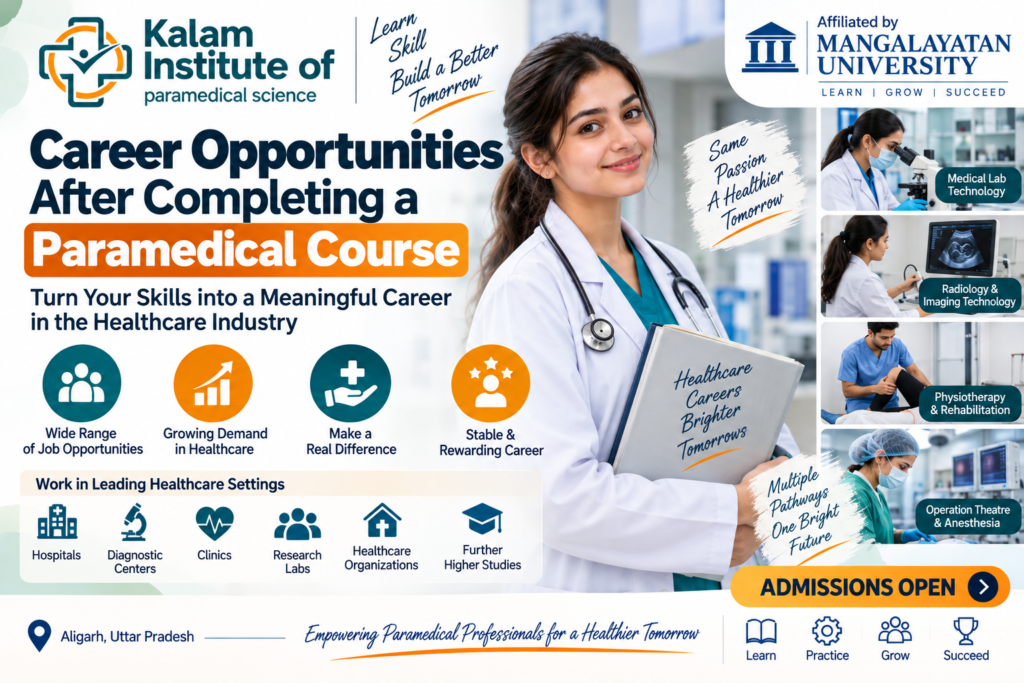
Career Opportunities After Completing a Paramedical Course | Affiliated by Mangalayatan University
The healthcare industry is much larger than hospitals and doctors. Behind every successful diagnosis, surgery, medical test, and imaging procedure, there is a team of trained professionals working together to provide quality healthcare.
Paramedical professionals are an important part of this healthcare team. They support doctors, nurses, radiologists, surgeons, and other healthcare professionals through diagnostic, technical, clinical, and patient-support services.
For students who want to enter the healthcare sector after Class 12, a paramedical course can open the door to several career paths.
From medical laboratories and radiology departments to operation theatres and diagnostic centres, trained paramedical professionals can work in a variety of healthcare environments.
Mangalayatan University currently offers paramedical programs including B.Sc. Medical Lab Technology, B.Sc. Medical Radiology & Imaging Technology, B.Sc. Operation Theatre Technology, as well as advanced diploma programs in these specializations. Its current 2026–27 admission information lists the undergraduate programs as three years plus internship and the advanced diploma programs as two years.
This guide explores the major career opportunities available after completing a paramedical course and explains how students can build a successful career in this growing field.
What Is a Paramedical Course?
Paramedical courses are specialized healthcare programs designed to prepare students for technical and supportive roles within the medical sector.
Unlike medical programs that train students to become doctors, paramedical courses focus on specific areas of healthcare such as:
- Medical laboratory technology
- Radiology and medical imaging
- Operation theatre technology
- Emergency healthcare
- Diagnostic services
- Patient-support services
- Medical equipment and clinical procedures
The responsibilities of a paramedical professional depend on their qualification, specialization, employer, and applicable professional regulations.
The main advantage of paramedical education is that students can select a specialization according to their interests rather than following a single healthcare career route.
Why Choose a Career in Paramedical Sciences?
Healthcare requires professionals with different types of expertise. Doctors may diagnose and treat patients, but diagnostic laboratories, imaging departments, operation theatres, and other clinical services also need trained technical staff.
Some important reasons to consider a paramedical career include:
Practical Career Opportunities
Paramedical courses generally combine theoretical education with practical learning. This helps students understand how healthcare procedures and technologies are used in real-world settings.
Multiple Specializations
Students can choose an area such as laboratory technology, radiology, or operation theatre technology based on their interests.
Healthcare Industry Exposure
Paramedical professionals can work in hospitals, clinics, diagnostic centres, laboratories, surgical facilities, and other healthcare organizations.
Scope for Professional Growth
With additional education, specialization, and experience, professionals can progress toward senior technical, supervisory, research, or management-related roles.
Popular Career Options After a Paramedical Course
The career opportunities available after completing a paramedical course depend largely on the specialization you choose.
Let’s look at some of the major career paths.
1. Medical Laboratory Technician
Medical Laboratory Technology is one of the most popular paramedical specializations.
Medical laboratory technicians work with clinical samples and perform laboratory procedures that support the diagnosis and monitoring of diseases.
Their work may involve:
- Blood testing
- Urine testing
- Sample preparation
- Microscopy
- Biochemistry testing
- Microbiology procedures
- Maintaining laboratory records
- Quality-control procedures
After completing a relevant qualification, students can explore positions such as Medical Laboratory Technician, Clinical Laboratory Technician, Research Laboratory Technician, and Quality Control Technician. Mangalayatan University’s current program information also lists laboratory-related career profiles including Laboratory Manager and Research Assistant for relevant qualifications.
Where Can Medical Lab Technicians Work?
They may find opportunities in:
- Hospitals
- Pathology laboratories
- Diagnostic centres
- Blood banks
- Research laboratories
- Medical testing facilities
- Pharmaceutical and biotechnology organizations
2. Radiology Technician
If you are interested in medical technology and diagnostic imaging, radiology can be a strong career direction.
Radiology and imaging professionals assist with procedures involving technologies such as X-ray, CT, MRI, and other diagnostic imaging systems, depending on their training and professional role.
Their responsibilities can include:
- Preparing patients for imaging
- Positioning patients correctly
- Operating relevant imaging equipment
- Following safety procedures
- Maintaining equipment and records
- Supporting image-quality requirements
Mangalayatan University offers a B.Sc. in Medical Radiology & Imaging Technology as well as an advanced diploma pathway.
Potential Career Roles
Depending on qualifications and specialization, graduates can explore roles such as:
- Radiology Technician
- Radiographer
- X-Ray Technician
- CT Technician
- MRI Technician
- Imaging Technician
- Radiologic Technologist
The university’s current Radiology & Medical Imaging Technology information identifies career opportunities including radiologic technologist and MRI technologist.
3. Operation Theatre Technician
Operation theatres require careful preparation, organization, sterilization, and technical support.
Operation Theatre Technology programs prepare students to support surgical teams and maintain the operation theatre environment.
Professionals may assist with:
- Preparing operation theatres
- Arranging surgical instruments
- Sterilization procedures
- Patient preparation
- Operation theatre equipment
- Maintaining sterile conditions
- Supporting surgical teams
- Post-operative theatre procedures
Mangalayatan University’s B.Sc. Operation Theatre Technology program is designed around areas such as anesthesia, surgical instrumentation, sterilization, patient care, and operating-room management.
Career Opportunities in Operation Theatre Technology
Graduates can explore roles such as:
- Operation Theatre Technologist
- Surgical Assistant
- Anesthesia Technologist
- Surgical Technologist
- Cardiovascular Technologist
- Emergency Room Technologist
- Operation Theatre Supervisor
Some specialized roles may require additional training or qualifications.
4. Research Laboratory Technician
Students who enjoy scientific investigation may consider laboratory research.
Research laboratory technicians can support scientific studies by:
- Preparing samples
- Maintaining laboratory equipment
- Recording observations
- Performing laboratory procedures
- Supporting research teams
- Following laboratory safety standards
Research opportunities can be found in universities, research institutions, biotechnology companies, pharmaceutical organizations, and healthcare research facilities.
5. Quality Control Professional
Accuracy is extremely important in healthcare laboratories.
Quality-control professionals help ensure that laboratory processes and procedures follow appropriate standards and produce reliable results.
Their responsibilities can include:
- Monitoring laboratory procedures
- Maintaining records
- Checking testing processes
- Identifying procedural issues
- Supporting quality-assurance activities
A quality-control career can be particularly relevant for students specializing in Medical Laboratory Technology.
6. Emergency Medical Technician
Emergency Medical Technicians work in urgent-care and emergency-response environments.
Their responsibilities can involve providing immediate assistance, supporting patient transportation, and working with emergency medical teams according to their training and scope of practice.
This career can be suitable for students who prefer fast-paced healthcare environments and are comfortable working under pressure.
7. Dialysis Technician
Dialysis is an important healthcare service for patients whose kidneys are unable to perform their normal functions adequately.
Dialysis technicians support dialysis procedures, operate relevant equipment, prepare patients and equipment, and monitor the technical aspects of the treatment according to established protocols.
This is a specialized career path and generally requires dedicated training in dialysis technology.
8. Anesthesia Technician
Anesthesia technicians support anesthesia teams before, during, and after medical procedures.
Their work can include preparing anesthesia equipment, maintaining supplies, assisting with equipment setup, and supporting the clinical team according to their professional responsibilities.
Students interested in operation theatre environments may consider specialized education in this area.
9. Optometry-Related Careers
Students interested in eye care can explore optometry and ophthalmic technology programs.
Depending on their qualification, professionals may work with eye-care teams and assist with diagnostic equipment, patient preparation, vision-related procedures, and clinical support.
This is another example of how paramedical education can lead to specialized healthcare careers.
10. Healthcare Administration and Management
With suitable education and experience, some paramedical professionals can move toward administrative and supervisory positions.
Possible areas include:
- Laboratory management
- Imaging-centre supervision
- Operation theatre management
- Healthcare operations
- Quality management
- Clinical coordination
Management roles generally require experience and, in some cases, additional qualifications in healthcare administration or management.
Where Can Paramedical Professionals Work?
One of the biggest advantages of paramedical education is the variety of healthcare environments where professionals may find opportunities.
Hospitals
Hospitals have multiple departments requiring laboratory, imaging, operation theatre, emergency, and other technical professionals.
Diagnostic Centres
Diagnostic centres depend on trained personnel to conduct laboratory and imaging procedures.
Pathology Laboratories
Medical laboratory professionals can work in pathology and diagnostic laboratories.
Imaging Centres
Radiology and imaging professionals can work with X-ray, CT, MRI, and other imaging services, depending on their training.
Surgical Centres
Operation Theatre Technologists can work in hospitals and surgical centres supporting surgical teams.
Research Institutions
Students interested in science and research can explore laboratory-based opportunities.
Pharmaceutical and Biotechnology Companies
Certain paramedical qualifications and additional skills can be useful for laboratory, quality, technical, and research-related roles in these industries.
Mangalayatan University describes paramedical professionals as working across hospitals, clinics, diagnostic laboratories, rehabilitation centres, and emergency-care units.
Government and Private Sector Career Opportunities
Paramedical professionals may explore opportunities in both government and private healthcare organizations.
Government Sector
Potential employment environments can include:
- Government hospitals
- Public healthcare facilities
- Government diagnostic laboratories
- Research institutions
- Health departments
- Public medical institutions
Recruitment requirements, examinations, age limits, and eligibility vary by organization and position.
Private Sector
Private healthcare provides opportunities in:
- Private hospitals
- Diagnostic centres
- Pathology chains
- Imaging centres
- Specialty hospitals
- Research organizations
- Healthcare companies
Private-sector career growth can depend on qualifications, practical skills, experience, specialization, and employer requirements.
Career Growth After a Paramedical Course
Completing a paramedical course is only the beginning of a professional journey.
A student may start with an entry-level technical role and gradually develop into a senior professional.
A possible career progression could look like:
Student → Junior Technician → Technician → Senior Technician → Supervisor → Manager
The exact path varies according to specialization.
For example, a Medical Laboratory professional may progress toward laboratory supervision or management, while an Operation Theatre professional may move into senior OT or surgical-services responsibilities.
Additional education and specialized certifications can also improve professional opportunities.
Higher Studies After a Paramedical Course
Students who want to continue their education can explore higher studies after completing an appropriate paramedical qualification.
Depending on their existing qualification and eligibility, options may include:
- Bachelor’s degree programs
- Postgraduate programs
- Advanced diplomas
- Specialized certifications
- Skill-development programs
- Research-oriented education
- Healthcare management programs
Higher education can help students develop specialized knowledge and prepare for more advanced professional responsibilities.
Skills That Can Improve Your Paramedical Career
A qualification provides the foundation, but professional skills can make a major difference.
Technical Skills
Understand the equipment, procedures, software, and technology used in your specialization.
Attention to Detail
Healthcare work requires accuracy. Small mistakes can affect patient care and diagnostic processes.
Communication
Paramedical professionals regularly interact with patients and healthcare teams.
Teamwork
Healthcare is a collaborative environment. Learning to work effectively with doctors, nurses, technicians, and administrative staff is important.
Time Management
Hospitals and diagnostic facilities can be busy. Professionals need to manage workloads efficiently while maintaining quality and safety.
Professional Ethics
Patient privacy, confidentiality, dignity, and responsible professional conduct should always be taken seriously.
Continuous Learning
Healthcare technology changes continuously. Professionals who keep updating their knowledge and skills can remain better prepared for changing workplace requirements.
Why Choose Mangalayatan University for Paramedical Education?
Mangalayatan University offers specialized paramedical programs through its paramedical education departments. Its current 2026–27 course listing includes B.Sc. Medical Lab Technology, B.Sc. Medical Radiology & Imaging Technology, B.Sc. Operation Theatre Technology, and corresponding advanced diploma programs.
The university describes its paramedical programs as skill-oriented courses intended to prepare students for different healthcare environments, including hospitals, clinics, diagnostic laboratories, rehabilitation centres, and emergency-care units.
When selecting a paramedical college, students should consider:
- Course curriculum
- Practical training
- Laboratory facilities
- Clinical exposure
- Faculty
- Internship opportunities
- Course duration
- Admission eligibility
- Fees
- Career-support services
- Opportunities for higher education
Choosing an institution should be based on the overall quality and relevance of the program rather than just the course name.
How to Choose the Right Paramedical Career
There is no single best paramedical career for every student.
Your choice should depend on your interests.
If You Like Laboratory Work
Medical Lab Technology may be a good fit.
If You Enjoy Technology and Machines
Radiology & Medical Imaging Technology may be worth exploring.
If You Are Interested in Surgery
Operation Theatre Technology could be suitable.
If You Like Emergency Situations
Explore Emergency Medical Services and related specialized training.
If You Enjoy Research
Consider laboratory research and biotechnology-related career paths.
Choosing a specialization based on your strengths and interests can make your professional journey more meaningful.
Is a Paramedical Course a Good Career Option?
A paramedical career can be a strong option for students who want to work in healthcare and are interested in technical, diagnostic, or clinical support roles.
The field offers multiple specializations, different work environments, and opportunities for professional development.
However, students should have realistic expectations. A successful career does not depend only on completing a course. Practical skills, professional discipline, communication, experience, specialization, and continuous learning all matter.
Frequently Asked Questions
What can I do after completing a paramedical course?
You can explore healthcare roles based on your specialization. These may include Medical Laboratory Technician, Radiology Technician, Operation Theatre Technologist, Research Laboratory Technician, Quality Control Technician, and other technical healthcare positions.
Which paramedical course has the best career scope?
There is no single course that is best for everyone. Medical Lab Technology, Radiology & Medical Imaging Technology, and Operation Theatre Technology can each lead to different career paths.
Can I get a government job after a paramedical course?
Yes, eligible candidates can apply for government healthcare positions when vacancies are available and they meet the specific qualification and recruitment requirements.
Can paramedical professionals work in private hospitals?
Yes. Private hospitals, diagnostic centres, imaging facilities, laboratories, and surgical centres employ qualified paramedical professionals.
Can I study further after completing a paramedical course?
Yes. Depending on your qualification and eligibility, you may pursue higher degrees, advanced diplomas, specialized certifications, or related healthcare-management programs.
What skills are important for a paramedical professional?
Technical knowledge, accuracy, communication, teamwork, patient sensitivity, time management, safety awareness, and continuous learning are valuable skills.
Does Mangalayatan University offer paramedical courses?
Yes. Its current 2026–27 admission information lists B.Sc. Medical Lab Technology, B.Sc. Medical Radiology & Imaging Technology, B.Sc. Operation Theatre Technology, and advanced diploma programs in these fields.
Conclusion
A paramedical course can open the door to a wide range of healthcare careers. Whether your interest lies in laboratory testing, medical imaging, operation theatres, research, emergency services, or healthcare technology, there are multiple directions you can explore.
The key is to choose a specialization that matches your interests, complete a suitable qualification, gain practical experience, and continue developing your professional skills.
Mangalayatan University’s current paramedical offerings provide students with different pathways in areas such as Medical Lab Technology, Radiology & Medical Imaging Technology, and Operation Theatre Technology.
For students planning a healthcare career after Class 12, paramedical education can be a practical starting point toward becoming a skilled member of the healthcare workforce.
Before enrolling, always check the latest course eligibility, curriculum, fees, internship details, and admission information directly with the university.